
A lender’s risk lead hears two things in the same week (a typical situation, not a client). The vendor of a new credit scoring model says a fundamental rights impact assessment is “a deployer matter”. The DPO says the data protection impact assessment already covers it. Both are half right.
A fundamental rights impact assessment under the AI Act, or FRIA, is a written assessment, made before first use, of what a high-risk AI system can do to the people it affects. Article 27 requires it from three kinds of deployer. They are bodies governed by public law, private entities providing public services, and deployers of two financial uses in Annex III. Those two are scoring the creditworthiness of natural persons (point 5(b)) and risk assessment and pricing in life and health insurance (point 5(c)).
A bank’s fraud model, a motor insurer’s pricing model and a private employer’s CV filter are outside it. A DPIA can supply parts of a FRIA, but the Article still asks for its own six elements.
The high-risk rules for Annex III systems apply from 2 December 2027, and we found no published template of the kind Article 27(5) promises. We read the Regulation and every source below on 15 November 2026. This is an engineer’s reading for your counsel to confirm, not legal advice.
What is a fundamental rights impact assessment under the AI Act?
It is the deployer’s own analysis of impact, not a certificate and not the provider’s paperwork. Recital 96 gives the aim: the deployer identifies “the specific risks to the rights of individuals or groups of individuals likely to be affected” and the measures to take “in the case of a materialisation of those risks”.
Three features matter in practice:
- It comes first. The assessment is done “prior to deploying” the system, and the duty “applies to the first use” (Article 27(1) and (2)). A FRIA written after go-live is a record, not an assessment. The ECNL and Danish Institute for Human Rights guide puts the test well: it “must inform deployment decisions, not merely justify them after the fact”.
- It uses the provider’s information, but it is yours. Element (d) must take into account the information the provider gives under Article 13, which includes the system’s accuracy metrics and, “when appropriate”, its performance for specific persons or groups. In similar cases a deployer may rely on earlier FRIAs or on existing impact assessments carried out by the provider (Article 27(2)).
- It is not a one-off. If a deployer considers that an element “has changed or is no longer up to date”, it must update the information.
Who needs a FRIA, and who does not?
Article 27(1) names three groups of deployers, and only for high-risk systems that Article 6(2) brings in through Annex III:
- Bodies governed by public law. The AI Act does not define the term, Securiti notes, while other EU legislation does. Ask counsel which definition applies to you.
- Private entities providing public services. Recital 96 says such entities are “linked to tasks in the public interest such as in the areas of education, healthcare, social services, housing, administration of justice”.
- Deployers of the two financial uses in Annex III points 5(b) and 5(c), public or private.
One exclusion: systems “in the area listed in point 2 of Annex III”, the safety components of critical digital infrastructure, road traffic and the supply of water, gas, heating or electricity.
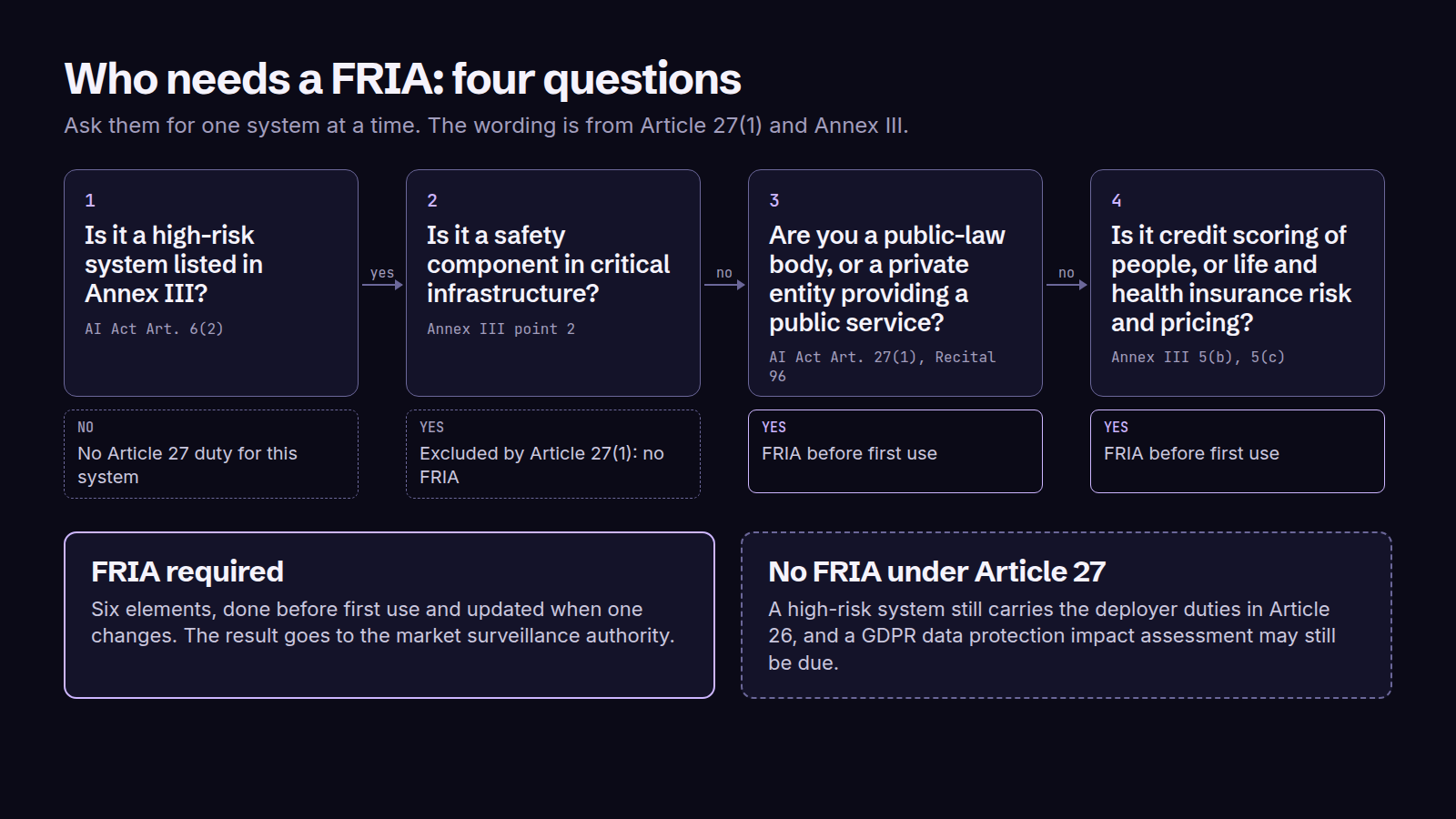
Who needs a FRIA: four questions in order, from Article 27(1) and Annex III.
Summaries are often wider than the text. One insurance guide, for example, tells insurers that use AI to “calculate premiums, assess eligibility or segment customer risk profiles” to conduct a FRIA, while point 5(c) covers life and health risk assessment and pricing only. The Commission’s draft classification guidelines show where the lines fall. Here are ten cases.
| Deployer and system | FRIA under Article 27? | Why |
|---|---|---|
| Bank or lender: scores consumers’ creditworthiness for a loan, mortgage or credit line | Yes | Annex III 5(b). Scoring for consumer credit is the Commission’s first example |
| Bank: detects forged IDs or altered income statements | No, on this route | 5(b) excludes systems used “for the purpose of detecting financial fraud”. The draft guidelines say fraud detection must be the main intended use |
| Bank: AML and counter-terrorist-financing alert files | No, unless the tool also evaluates creditworthiness | The draft guidelines say AML tools get no fraud exception, and they are outside 5(b) to the extent their intended use does not cover creditworthiness |
| Lender: scores companies from balance sheets | No, if it assesses companies only | 5(b) names natural persons. The draft guidelines count sole traders and other self-employed people as natural persons, except where the system uses only business data |
| Life or health insurer: risk assessment or pricing for individuals | Yes | Annex III 5(c). The draft guidelines include long-term care and credit life cover |
| Motor or home insurer: pricing | No | 5(c) covers life and health only |
| Health insurer: checks a claim against policy terms, sets the amount | No | The draft guidelines treat claims management as outside 5(c) |
| Private employer: filters job applications (Annex III 4(a)) | No | Not a public-law body or a public-service provider. Article 26 duties still apply |
| Public authority: evaluates eligibility for public assistance benefits (5(a)) | Yes | Public-law body, Annex III system outside point 2 |
| Grid operator: safety component in electricity supply (point 2) | No | Expressly excluded |
Four traps to watch:
- One system, one verdict. The draft guidelines say that when several AI components together shape an individual decision, the combined configuration “is treated as a single AI system”. They add that this “extends to” agentic AI systems that coordinate through linked actions. Our reading: an agent that prepares loan files and also outputs a creditworthiness score is a 5(b) system, whatever the modules are called.
- A person signing does not change the class. Per the draft guidelines, human involvement “has no effect on the classification” under Article 6(2). Deployers must assign human oversight to people with “the necessary competence, training and authority” (Article 26(2)), and element (e) of the FRIA describes it.
- Profiling closes the escape route. An Annex III system “shall always be considered to be high-risk where the AI system performs profiling of natural persons” (Article 6(3)). Our reading is that credit scoring will rarely use the Article 6(3) filter. Counsel should confirm it for your case.
- Building it yourself does not remove the duty. A provider “puts the AI system into service under its own name”, and putting into service includes supply “for own use” (Article 3). Our reading: a bank that builds a scoring model and uses it is provider and deployer.
The guidelines are a draft. The Commission says they are not legally binding but reflect its interpretation, and a consultation on them was open until 23 July 2026. Recheck every row when the final text appears. For the classification itself, our post on the AI Act for companies deploying agents covers risk classes and roles.
When do you have to do it, and when do you update it?
Before the first use of the system. The date to plan against is 2 December 2027. The Commission’s AI Omnibus page says the high-risk rules in Annex III apply from then. The amended Article 113 says Chapter III, Sections 1, 2 and 3 apply from 2 December 2027 for systems classified under Article 6(2) and Annex III. Article 27 sits in Section 3, so its date follows (Particula makes the same point, and the aiactblog.nl analysis says Article 27 “follows the high-risk timeline”).
A system you already run is treated differently. Under the amended Article 111(2), the Regulation applies to operators of high-risk systems placed on the market or put into service before the date of application of Chapter III. It does so “only if, as from that date, those systems are subject to significant changes in their designs”. Providers and deployers of systems intended for public authorities must comply “by 2 August 2030”. Counsel should confirm how that combines with the significant-change rule, and what counts as a significant change. The Commission lists guidelines on substantial modification among its open work.
After go-live, Article 27(2) is the update rule. Our triggers, which are suggestions and not the Article’s list:
- a new model version, or a change to what the system outputs about a person;
- a new customer segment, product or channel;
- a complaint pattern or an incident that points at a group of people;
- new or revised instructions for use from the provider;
- a scheduled review, at least once a year.
What goes in a FRIA? The six elements of Article 27(1)
The Article lists six elements, and each is easy to answer thinly. Here is what we would write for each, and where the input comes from.
| Element in Article 27(1) | What to write | Input |
|---|---|---|
| (a) The deployer’s processes in which the system is used, in line with its intended purpose | The business process around the system: where it sits, what it feeds, who decides next | Process owner, provider’s stated intended purpose |
| (b) The period and frequency of use | Start date, end date if any, volume and rhythm, such as every application or each renewal | Operations, the rollout plan |
| (c) Categories of natural persons and groups likely to be affected | Named categories, not “customers”: applicants, co-applicants, sole traders, older people, people with thin credit files | Provider’s information on performance for groups, your own customer data |
| (d) Specific risks of harm to those people | Risks by right, with likelihood and severity: for example wrongful refusal, indirect discrimination, loss of access to an essential service | Provider’s Article 13 information, testing on your own cases |
| (e) Human oversight, according to the instructions for use | Who reviews, with what competence and authority, what they can override, and how you notice automation bias | Instructions for use, Article 26(2), your oversight design |
| (f) Measures if the risks materialize, including internal governance and complaint mechanisms | Who can suspend the system, how a person challenges an outcome, who answers, in what time | Complaints process, incident rules, the suspend duty in Article 26(5) |
Article 27 speaks of the impact “on fundamental rights” without listing them. The EU Charter of Fundamental Rights is the natural checklist. For a lending or insurance system the ones that come up are Article 8 (protection of personal data), Article 21 (non-discrimination), Article 38 (consumer protection) and Article 47 (an effective remedy). Recital 96 adds that deployers “could involve relevant stakeholders”, including representatives of affected groups, independent experts and civil society organizations. The word is “could”, so it is optional. We would do it for any model that sets what people pay.
Element (e) is the one to write with care. We cover how to design that step in human oversight in practice.
Can you build a FRIA on your DPIA?
Partly, and the law now says so more openly than it did. The text of Article 27(4) as first published said the FRIA “shall complement that data protection impact assessment”.
The text the Commission’s AI Act Service Desk now shows, with paragraphs 4 and 5 marked as amended, says the deployer “may” include cross-references “to the relevant sections of that data protection impact assessment or include relevant parts thereof”. ISMS.online reads that as the Omnibus allowing reuse. ECNL welcomed that the FRIA was kept, and the cross-reference is an approach it had recommended.
In practice that means reuse, not substitution. As ECNL puts it, deployers must still “assess the impact on fundamental rights before deploying a system”.
Why the DPIA alone does not do the job is clear from the DPIA’s own guidance. The Article 29 Working Party’s guidelines say the “rights and freedoms” in Article 35 “primarily” concern data protection and privacy, though they may touch other fundamental rights. Its checklist for an acceptable DPIA frames risk through “illegitimate access, undesired modification and disappearance of data”. A FRIA’s risk is a refused loan or a premium that tracks a protected characteristic. ECNL’s complaint is that DPIAs are “neither published nor, in practice, comprehensive in their coverage of fundamental rights”.
The overlap is real, though, and it starts at the provider. Article 26(9) tells deployers to use the Article 13 information for their DPIA, and Article 27(1)(d) points to the same information for the FRIA. At an IAPP conference, an EDPB legal officer said that “if one needs a fundamental rights impact assessment, most likely you need a data protection impact assessment, but the reverse isn’t necessarily true”. Joint guidelines of the Commission and the EDPB on the interplay are expected.
Here is our field-by-field reading of what carries over from a DPIA built to GDPR Article 35(7):
| FRIA element, Article 27(1) | Closest DPIA content | Reuse | What to add |
|---|---|---|---|
| (a) Processes | 35(7)(a): systematic description of the processing and its purposes | Most of it | The business process and decision around the system |
| (b) Period and frequency | 35(7)(a) description; the WP29 checklist adds the storage period | Partly | How often and for how long the system is used |
| (c) Persons and groups | Data subjects in the processing | Partly | Groups affected by the use, including people not in the data |
| (d) Specific risks of harm | 35(7)(c): risks to rights and freedoms of data subjects | The data risks | Charter rights beyond data protection: non-discrimination, redress, access to a service |
| (e) Human oversight | No equivalent element | Little | Write it new, from the instructions for use |
| (f) Measures, governance, complaints | 35(7)(d): measures to address the risks, safeguards | Security and safeguards | Suspend rules, escalation, complaint route |
| Not in a FRIA | 35(7)(b): necessity and proportionality | Stays in the DPIA | Nothing to move |
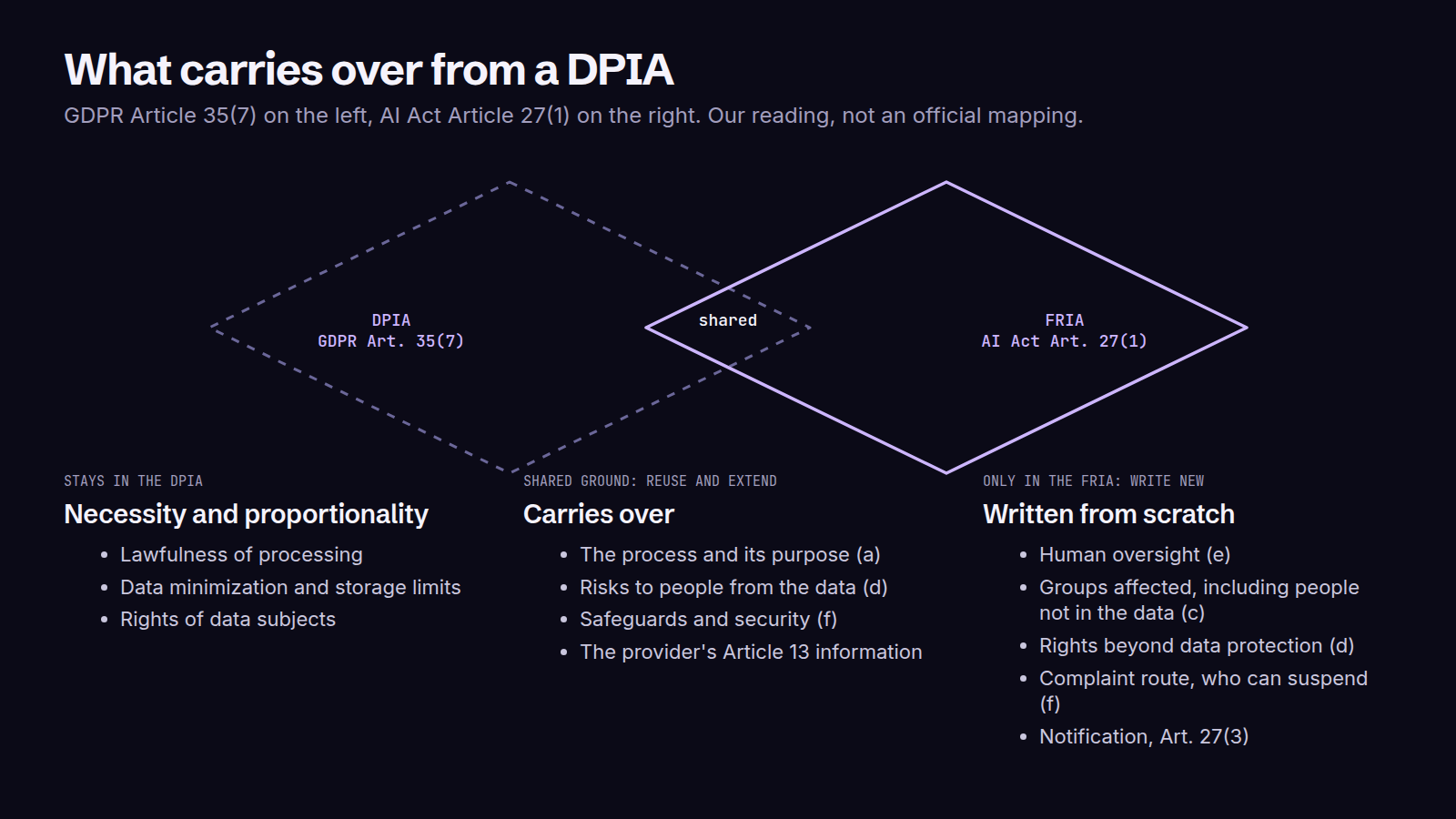
What carries over from a DPIA, and what has to be written new. Our reading, not an official mapping.
We would keep two documents and cross-reference by section number: the DPO signs the DPIA, and the process owner signs the FRIA. Whatever you choose, the DPIA gives you a head start. The rest is the part that was never about personal data. Our post on GDPR and AI agents covers the DPIA side.
Who do you notify, and is there a template?
Article 27(3) says that once the assessment is done, the deployer “shall notify the market surveillance authority of its results”, submitting the filled-out template from paragraph 5. Deployers “may be exempt” in the case of Article 46(1), the exceptional derogation a market surveillance authority can grant for reasons such as public security.
Which authority? For banks and insurers, our reading of Article 74(6) is that it is the financial supervisor. For high-risk systems “used by financial institutions regulated by Union financial services law”, the market surveillance authority is “the relevant national authority responsible for the financial supervision of those institutions”. That holds in so far as the use is “in direct connection with the provision of those financial services”. For other deployers, including a lender that is not a regulated financial institution, ask counsel which authority your Member State designated.
Which template? Article 27(5) tells the AI Office to develop “a template for a questionnaire, including through an automated tool”, and says it should let deployers include cross-references to the DPIA. As far as we could establish on 15 November 2026, it has not been published:
- the Commission’s guidelines page, last updated 31 July 2026, lists “Guidelines with a template for the fundamental rights impact assessment” among the sets the AI Office “keeps working on”;
- the Commission’s draft classification guidelines say the deployer duties around Article 27 “will be clarified in other set of guidelines that the Commission is preparing in 2026”;
- the aiactblog.nl guide recorded the same position on 10 October 2026.
Nobody can file the official template yet, and the duty starts on 2 December 2027. Write to the six elements now.
For method, the ECNL and Danish Institute for Human Rights guide of December 2025 is the most developed we found. It is built in five phases and written mainly for public authorities. The network of national human rights institutions, ENNHRI, has asked the Commission to consult publicly on the template. Keep your answers in labeled fields, one per element, so that moving them into the official form later is copying and not rewriting.
Two smaller points. First, registration. Deployers that are public authorities, Union bodies or persons acting on their behalf register themselves and the use in the EU database (Article 49(3)). Their entry includes “a summary of the findings of the fundamental rights impact assessment” (Annex VIII, Section C). In our reading, a private bank or insurer is not in that group.
Second, penalties. The fines listed in Article 99(4), up to EUR 15 million or 3% of worldwide annual turnover, name the deployer duties of Article 26. We did not find Article 27 in that list, and the aiactblog.nl guide reads it the same way. Article 99(1) still requires Member States to set penalties for “any infringement” by operators, so confirm the national position with counsel.
What does a FRIA look like in practice?
Example, not a client. A consumer lender deploys a creditworthiness scoring model it bought from a vendor, to rank applications for unsecured loans. It is a 5(b) system, and the lender is the deployer. This is how the six elements could read.
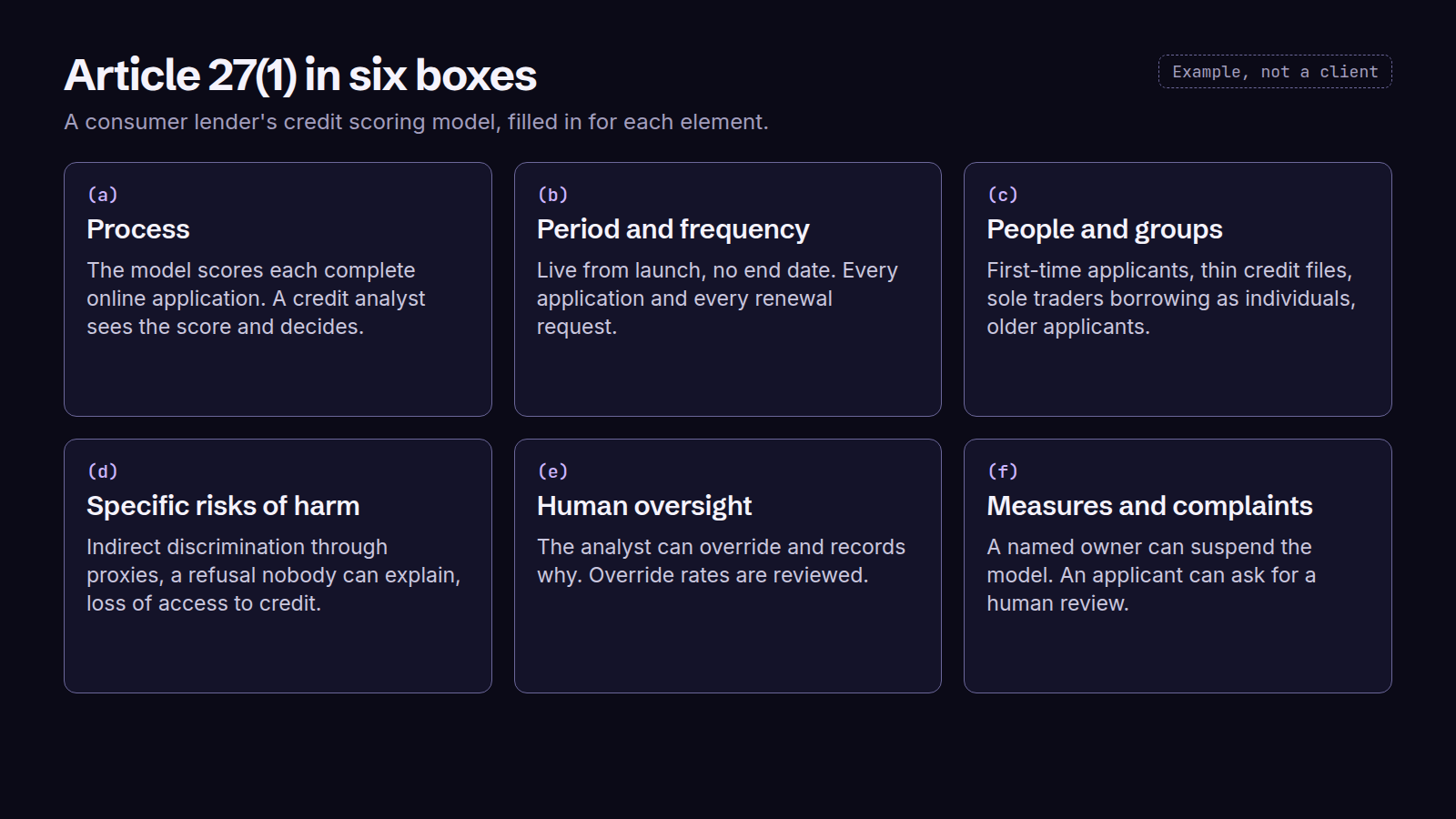
Example: the six elements filled in for one scoring model.
- (a) Process. The model scores every complete online application. A credit analyst sees the score and the main factors, and decides.
- (b) Period and frequency. Live from the launch date, with no end date, scoring each application and each renewal request.
- (c) People. First-time applicants, applicants with thin credit files, sole traders borrowing as individuals, and older applicants. The list comes from the provider’s group-level performance figures and the lender’s own applicant mix.
- (d) Risks. Indirect discrimination through proxies such as postcode, refusal that cannot be explained to the applicant, and loss of access to credit. Each gets a likelihood and severity rating and a test on the lender’s own historical cases.
- (e) Oversight. The analyst can override the score and must record why. The lender checks override rates so it can see whether people simply follow the number.
- (f) Measures. A named owner can suspend the model. An applicant can ask for a human review through a published route, with a reply deadline set by the lender’s complaints policy.
The same lender’s loan-triage agent only chases missing documents and never outputs a score. Provided it does not feed or shape the scoring decision, it is not a 5(b) system and needs no FRIA under Article 27 on that basis. If it does feed the score, the combined configuration may count as one 5(b) system. Either way, whether it needs a DPIA depends on the GDPR Article 35 test.
What mistakes should you avoid, and what must counsel confirm?
Mistakes to avoid:
- Treating the duty as universal. Check the use case against 5(b) and 5(c), not the sector.
- Pasting the DPIA in and stopping. The Article asks for harms to rights beyond data protection, human oversight and complaint routes.
- Writing it after launch. The test is whether the assessment could have changed the decision.
- One person, one afternoon. ECNL calls the pull toward a “simple checklist” “inherently dangerous” and asks for a structured discussion. Involve the process owner, the DPO, risk, and someone who sees the complaints.
- Leaving oversight vague. “A human reviews it” is not a description.
- Waiting for the template. The six elements are already in the Article, so the analysis behind them can start now.
What counsel must confirm for your case:
- whether each system is high-risk under Annex III, and whether Article 6(3) can apply;
- whether your organization is a body governed by public law or a private entity providing public services;
- that 2 December 2027 is the date that applies to your system under Article 113 as amended;
- whether a running system has had a significant change in design (Article 111(2));
- which authority receives the notification, and its national procedure;
- the amended wording of Article 27 in the Official Journal. We read it through the Commission’s Service Desk, which marks paragraphs 4 and 5 as amended.
How do we help with a FRIA at Wise Agents?
We prepare the inputs: the process, the people affected, the oversight, the complaint route, the test results and the data path. The assessment itself stays with you, because the Regulation puts it on the deployer. When an agent does fall under 5(b) or 5(c), we build it with your risk and compliance teams in the room, to the Article 9 to 15 requirements. Our AI Act page maps each article to our method, what the platform keeps and what stays with you.
That input pack is what we would want to receive if we were the compliance lead. Bring one process. In 45 minutes you get a first view of its risk class, the controls it needs and whether an agent is the right tool at all. Book a scoping call.
Questions
Do all banks and insurers need a FRIA?
No. Article 27 reaches deployers of two financial uses: creditworthiness scoring of natural persons (Annex III 5(b)) and risk assessment and pricing for life and health insurance (5(c)). A bank's fraud-detection tool, a motor pricing model or a claims agent is not covered on that route. Public-law bodies and private providers of public services have their own, wider trigger.
Is a FRIA the same as a DPIA?
No. A DPIA under GDPR Article 35 assesses risks to the rights and freedoms of data subjects from processing personal data. A FRIA under Article 27 of the AI Act assesses the impact of a high-risk AI system on fundamental rights more widely. Since the Digital Omnibus on AI, the FRIA may cross-reference a DPIA or include relevant parts of it.
When does the FRIA duty start?
It follows the Annex III high-risk rules, which apply from 2 December 2027 under Article 113 as amended. The FRIA must be done before the first use of the system. Systems already in use before that date are caught only if they later undergo significant changes in design, with a 2 August 2030 backstop for public authorities (Article 111(2)).
Is there an official FRIA template?
Not yet, as far as we found on 15 November 2026. Article 27(5) tells the AI Office to develop a questionnaire template, and the Commission lists guidelines with a FRIA template among work still in progress (page updated 31 July 2026). Start from the six elements in Article 27(1) and keep your answers structured.
Who receives the FRIA results?
The market surveillance authority, under Article 27(3). For high-risk systems used by financial institutions regulated by Union financial services law, Article 74(6) makes the national financial supervisor that authority, as far as the use is directly connected with the financial services. Confirm the designation in your Member State with counsel.
Sources
- ai-act-service-desk.ec.europa.euai-act-service-desk.ec.europa.eu/en/ai-act/article-27
- ai-act-service-desk.ec.europa.euai-act-service-desk.ec.europa.eu/en/ai-act/recital-96
- ai-act-service-desk.ec.europa.euai-act-service-desk.ec.europa.eu/en/ai-act/annex-3
- ai-act-service-desk.ec.europa.euai-act-service-desk.ec.europa.eu/en/ai-act/article-6
- ai-act-service-desk.ec.europa.euai-act-service-desk.ec.europa.eu/en/ai-act/article-3
- ai-act-service-desk.ec.europa.euai-act-service-desk.ec.europa.eu/en/ai-act/article-13
- ai-act-service-desk.ec.europa.euai-act-service-desk.ec.europa.eu/en/ai-act/article-26
- ai-act-service-desk.ec.europa.euai-act-service-desk.ec.europa.eu/en/ai-act/article-46
- ai-act-service-desk.ec.europa.euai-act-service-desk.ec.europa.eu/en/ai-act/article-49
- ai-act-service-desk.ec.europa.euai-act-service-desk.ec.europa.eu/en/ai-act/annex-8
- ai-act-service-desk.ec.europa.euai-act-service-desk.ec.europa.eu/en/ai-act/article-74
- ai-act-service-desk.ec.europa.euai-act-service-desk.ec.europa.eu/en/ai-act/article-99
- ai-act-service-desk.ec.europa.euai-act-service-desk.ec.europa.eu/en/ai-act/article-111
- ai-act-service-desk.ec.europa.euai-act-service-desk.ec.europa.eu/en/ai-act/article-113
- digital-strategy.ec.europa.eudigital-strategy.ec.europa.eu/en/news/ai-omnibus-enters-force
- digital-strategy.ec.europa.eudigital-strategy.ec.europa.eu/en/news/supporting-implementation-ai-act-clear-guidelines
- digital-strategy.ec.europa.eudigital-strategy.ec.europa.eu/en/policies/guidelines-ai-high-risk-systems
- ec.europa.euec.europa.eu/newsroom/dae/redirection/document/128561
- gdpr-info.eugdpr-info.eu/art-35-gdpr/
- ec.europa.euec.europa.eu/newsroom/article29/redirection/document/47711
- www.mishcon.comwww.mishcon.com/eu-uk-ai-navigator/article-27
- www.isms.onlinewww.isms.online/artificial-intelligence/how-has-the-eu-digital-omnibus-on-ai-changed-the-ai-act/
- iapp.orgiapp.org/news/a/a-view-from-brussels-a-sneak-peek-into-upcoming-guidelines-on-gdpr-ai-act-interplay
- ecnl.orgecnl.org/news/ai-omnibus-deregulation-expense-fundamental-rights
- ecnl.orgecnl.org/publications/guide-fundamental-rights-impact-assessments-fria
- cncdh.frcncdh.fr/sites/default/files/2025-04/ENNHRI-statement-on-ensuring-effective-Fundamental-Rights-Impact-Assessments-FRIAs-under-the-EU-AI-Act.pdf
- www.europarl.europa.euwww.europarl.europa.eu/charter/pdf/text_en.pdf
- www.aiactblog.nlwww.aiactblog.nl/en/posts/fria-complete-guide-article-27-ai-act
- www.aiactblog.nlwww.aiactblog.nl/en/posts/digital-omnibus-ai-act-simplification-or-erosion
- particula.techparticula.tech/blog/fundamental-rights-impact-assessment-ai-act
- www.aigl.blogwww.aigl.blog/a-guide-to-fundamental-rights-impact-assessments-fria/
- securiti.aisecuriti.ai/blog/fundamental-rights-impact-assessment-under-eu-ai-act/
- blogs.sas.comblogs.sas.com/content/hiddeninsights/2025/04/24/preparing-for-the-eu-ai-act-in-insurance
- ai-act-service-desk.ec.europa.euai-act-service-desk.ec.europa.eu/en/ai-act/article-70
Read on or before 15 November 2026. Not legal advice: your counsel and data protection officer decide.
Related posts

AI Act high risk insurance and banking: which AI is listed?
AI Act high risk insurance and banking rules, process by process: what Annex III lists, what it leaves out, and the date your team should plan against.
Read
AI Agent Audit Logs: What to Record and How Long to Keep It
AI agent audit logs: the fields to record for every run, what AI Act Articles 12, 19 and 26(6) and GDPR say about keeping them, and a review routine.
Read
AI Literacy Training: What Article 4 Asks, and a Staff Plan
AI literacy under Article 4 now means supporting it, not guaranteeing it. What changed, who enforces it, and a training plan by role for 200 people.
Read