
Two requests reach a compliance officer in the same week (a typical situation, not a client). A claims team wants an agent that triages claims. A lending team wants one that scores applicants. Both call it “just automation”. Under the AI Act the first is probably outside the high-risk list and the second very likely inside it.
Whether insurance or bank AI is high-risk depends on the process, not the sector. Annex III names two financial uses: evaluating the creditworthiness of natural persons or establishing their credit score (point 5(b)), and risk assessment and pricing for natural persons in life and health insurance (point 5(c)). From 2 December 2027 those systems carry the high-risk rules. Claims handling, complaints and customer questions are, in most designs, not on the list. Neither are anti-money-laundering (AML) checks, unless they are also intended to evaluate creditworthiness.
We read the Regulation’s text, the Commission’s draft classification guidelines and the sector regulators’ papers on 15 November 2026. This is an engineer’s reading for your counsel to confirm, not legal advice.
How do you test a process against the high-risk list?
Start with one process, not the whole product, and ask five questions in order. The first three settle most cases.
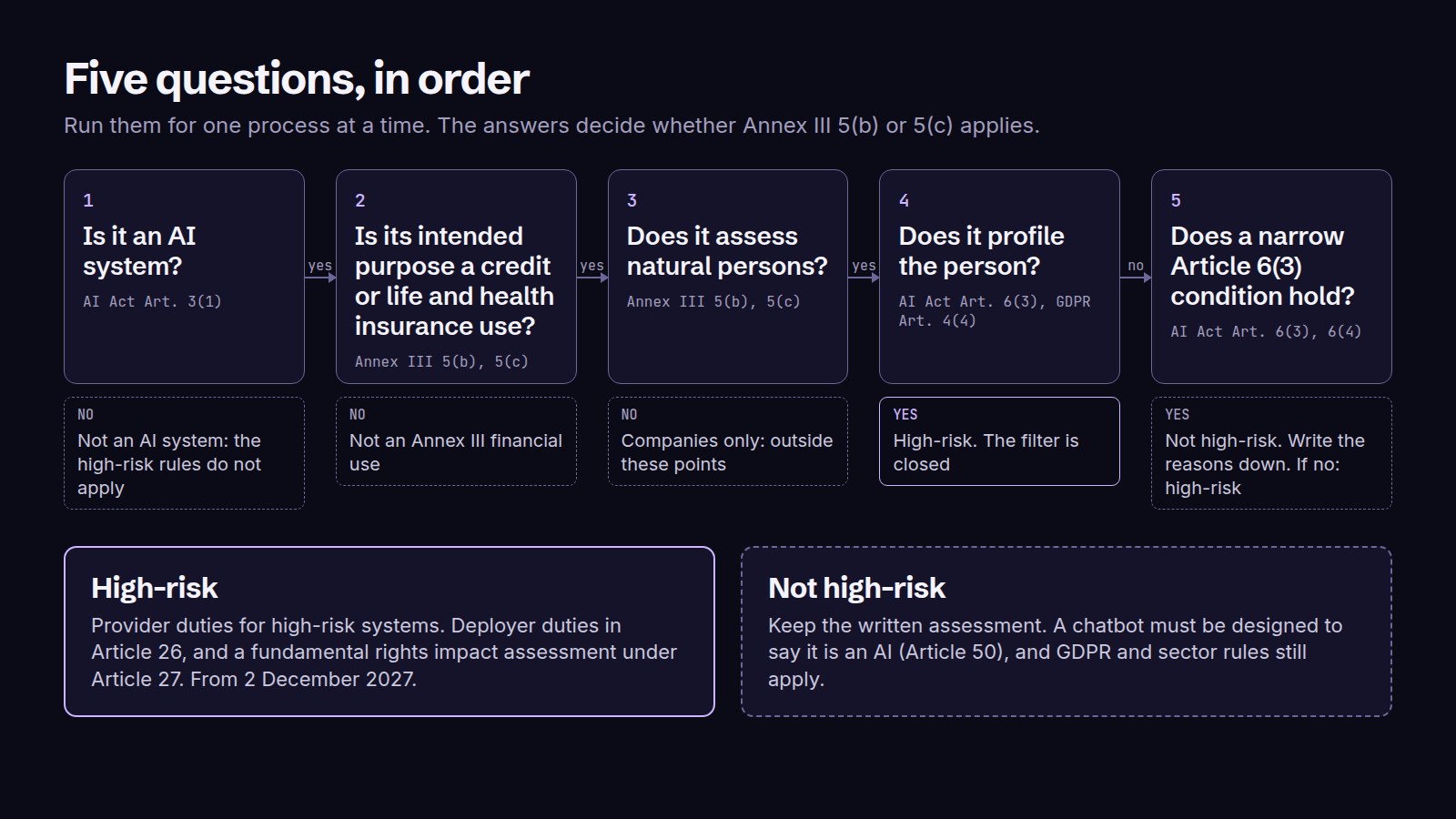
The test in order. The last box is an exception: the draft guidelines say the Article 6(3) conditions must be “interpreted narrowly”.
- Is it an AI system? The Commission’s draft guidelines say not every software application or automated decision-making system is in scope. Only systems that meet the definition in Article 3(1) qualify.
- Is its intended purpose on the list? The test is the purpose the provider states, “including the specific context and conditions of use”, across instructions, sales material and documentation. If the stated purpose has no Annex III use, Article 6(2) does not apply. The caution on sales material below still holds.
- Does it assess natural persons? Annex III 5(b) and 5(c) both say natural persons, and the draft guidelines include sole traders and self-employed people. A system that assesses companies from their balance sheets, and not anyone’s personal finances, is outside 5(b).
- Does it profile? An Annex III system “shall always be considered to be high-risk where the AI system performs profiling of natural persons” (Article 6(3)). Profiling evaluates personal aspects, such as a person’s economic situation, by automated processing.
- Does an Article 6(3) condition apply? An Annex III system is not high-risk if it poses no significant risk of harm and meets one of four conditions. It performs a narrow procedural task. It improves the result of a previously completed human activity. It detects decision-making patterns without replacing or influencing the human assessment. Or it performs a preparatory task.
Our reading of question 4 for banks: evaluating creditworthiness means assessing a person’s ability and willingness to pay, which is an economic situation. So the Article 6(3) filter will rarely rescue a 5(b) system. Counsel should confirm that for your case.
If you rely on the filter, write it down. Under Article 6(4), the provider must document its assessment before the system is placed on the market or put into service. Article 49(2) adds registration. In the Commission’s consolidated text it reads:
“Before placing on the market or putting into service an AI system for which the provider has concluded that it is not high-risk according to Article 6(3), that provider or, where applicable, the authorised representative shall register themselves and that system in the EU database referred to in Article 71.”
The Commission says the Omnibus simplifies this registration, so check the wording in force when you register.
What does Annex III 5(b) cover for banks, and what does it leave out?
Point 5(b) covers “AI systems intended to be used to evaluate the creditworthiness of natural persons or establish their credit score, with the exception of AI systems used for the purpose of detecting financial fraud”. The draft guidelines read that as two separate uses. Either one is enough, and a score can be a number, a ranking or a label. Their worked example of a high-risk 5(b) system is a credit score that supports a decision on consumer credit or a mortgage.
Three cases inside 5(b) are easy to miss:
- Scores shared with someone else. A credit agency’s score that a third party uses to decide on a loan, or on housing, healthcare or telecom access, is covered. The deployer does not have to be the one deciding.
- Assessment and pricing together. A pricing-only system is not covered. One that assesses creditworthiness and sets the price in one integrated process is.
- Essential private services. These include a bank account, payment services (including a temporary overdraft provided as an ancillary feature), loans, extending a credit line or a card limit, and a mortgage. Buying securities, margin trading, premium credit cards and leisure or travel loans are not essential. A system intended for both kinds is high-risk.
That is a wide net for lending, but it is not the whole of banking. The draft guidelines place these outside 5(b):
- Help with the application, such as explaining terminology or completing the form, as long as the assistant takes no part in the formal scoring.
- Monitoring credit exposure after the loan, solely for internal prudential purposes.
- Collateral valuation, so long as the system is used solely in relation to the collateral asset.
- Customer segmentation, personalized marketing and pricing simulations, while they stay distinct from the creditworthiness assessment.
The fraud exception is narrower than it sounds. Fraud detection must be the main intended use, as with a tool that spots forged ID cards or altered income statements. Then the exception holds even if the output later feeds a creditworthiness assessment.
Two traps for banks:
- AML tools get no fraud exception. The guidelines treat anti-money-laundering and counter-terrorist-financing work as separate from financial fraud. Those tools are out of scope only while they are not also intended to evaluate creditworthiness.
- One system, two jobs. A system that also feeds your internal ratings or capital calculation is still high-risk if it is also intended to do the 5(b) job. If the bank runs two separate systems, the internal-ratings system on its own is not high-risk.
Which insurance AI is high-risk under the AI Act?
Only AI for “risk assessment and pricing in relation to natural persons in the case of life and health insurance” (point 5(c)). Risk assessment means evaluating a person’s risk profile to decide whether to offer, deny, revoke or deliver cover. Pricing means the methods and criteria used to set the premium. Either one alone is enough.
The draft guidelines are broader than the words “life and health” suggest. They count private long-term care insurance and, where they can significantly affect a person’s livelihood in old age, personal pension products. They count credit life insurance. The accident and sickness classes of Solvency II count as health insurance. A health insurer based on public law is covered too.
They are narrower in the places where most insurers actually use agents:
- Motor, home and other insurance services are not covered, and insurance-based investment products are not life or health insurance.
- Claims management is outside. The Commission’s example is a health insurance system that verifies whether a claim is valid under the policy terms or determines the amount to pay. These are “distinct from carrying out a risk assessment or pricing”. Systems that validate claimant information against databases may also fall outside.
- Product design for life insurance is outside, as long as it does not assess or price individual cases.
Then comes fraud, where the two points differ. Point 5(c) has no fraud-detection exception. A life or health risk system is high-risk “even if it also has a feature that can be used for fraud detection”. Only a fraud feature that is “a distinct system in its own right” falls outside. Our reading: if your underwriting model and your fraud flag share one model and one output, expect them to be treated as one system.
Ten processes, one verdict each
Each row asks what the system is intended to do. Change the intended purpose and the verdict can change. Paragraph and section numbers point to the Commission’s draft guidelines on the Annex III use cases, so your counsel can check each row.
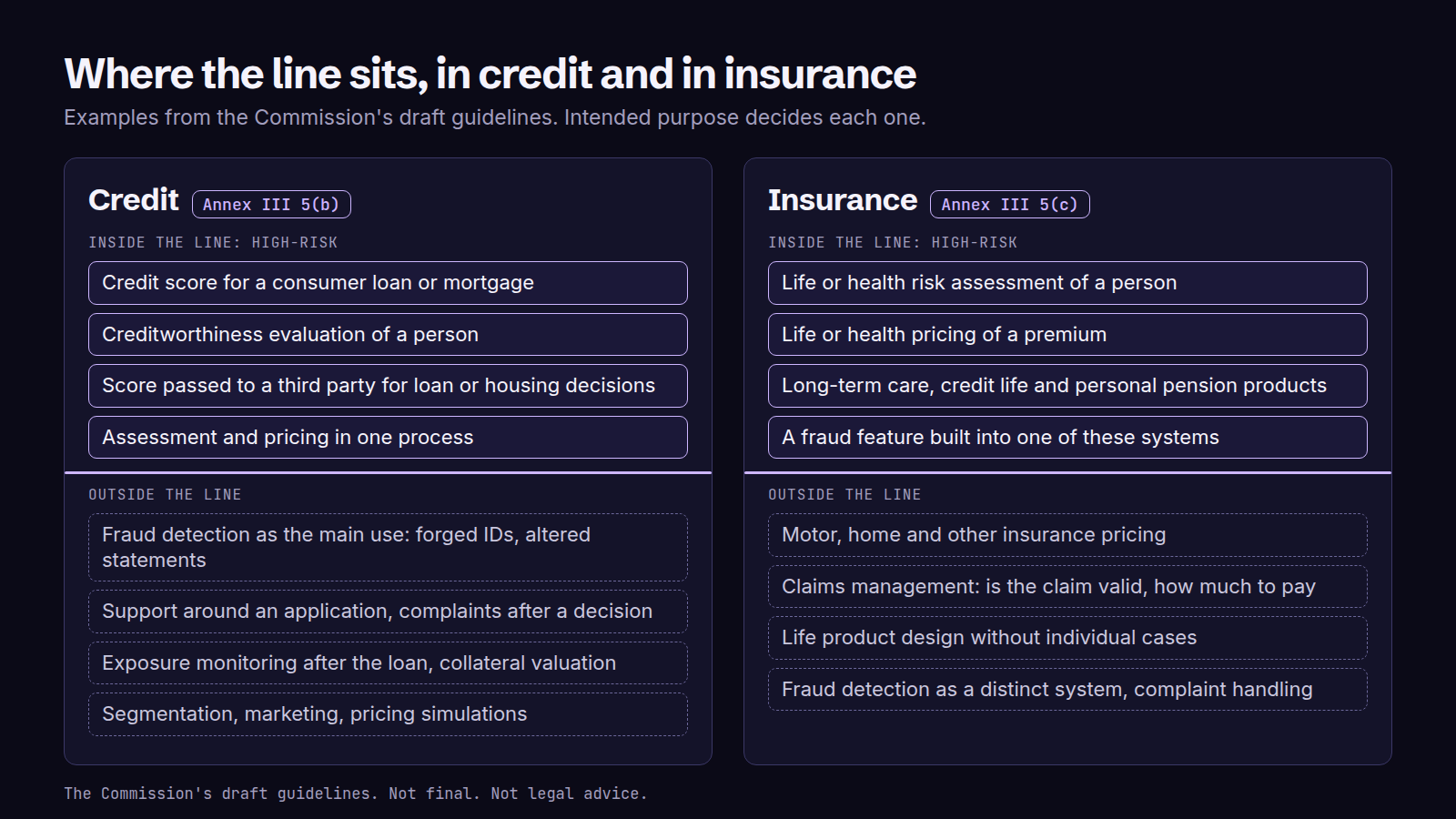
Where the line sits, from the Commission’s draft guidelines (draft, not final).
| Process | Annex III | Verdict | Why |
|---|---|---|---|
| Scoring a consumer’s credit, or evaluating creditworthiness for a loan, mortgage or credit line | 5(b) | High-risk | Worked example in section 3.5.3 |
| Detecting forged IDs or altered income statements in a credit application | 5(b) exception | Not high-risk if fraud detection is the main intended use | Fraud exception in point 5(b); paras. 306 and 307 |
| AML and counter-terrorist-financing checks and alerts | None named | Not listed, unless also intended to evaluate creditworthiness | Para. 309: no fraud exception, but out of scope unless functionally linked to credit scoring |
| Underwriting or pricing life, health, long-term care or credit life cover for individuals | 5(c) | High-risk | Paras. 312 to 314: risk assessment and pricing of natural persons |
| Pricing or underwriting motor or home cover | None | Not listed | Para. 314: other insurance services, such as motor and home, are not covered |
| Claims handling: checking a claim against the policy, setting the amount to pay | None | Not listed | Claims management example in section 3.5.4 |
| Fraud detection in insurance | 5(c) has no exception | Depends on the design | Para. 321: outside if a distinct system, high-risk if a feature of a life or health risk system |
| Handling complaints after a loan or a life or health insurance decision | None | Not listed, unless it also scores | Example in section 3.5.3: a separate stage where people challenge a decision |
| Customer chatbot that answers questions or explains an application form | None | Not high-risk; it must be designed to tell people it is an AI, unless that is obvious | Support example in section 3.5.3; Article 50(1) applies |
| Document extraction: turning files into structured data, sorting, finding duplicates | None, or the filter | Not listed on its own; inside a listed process it may qualify for the narrow-task filter, if it does not profile and does not materially influence the decision | Recital 53 and para. 91 give these as narrow procedural tasks |
Read the table with three cautions.
One system, one verdict. When several AI components together shape an individual decision, the draft guidelines treat the combined configuration as a single system (para. 75). They extend this to “agentic AI systems that coordinate and interact through linked actions”. Our reading: a claims agent that also produces a life or health risk score for a person is a 5(c) system, and splitting it into modules does not change that. Strictly procedural or preparatory functions that are “genuinely separable” can still use the filter.
A person signing does not change the class. The guidelines say human involvement “has no effect on the classification” under Article 6(2) (para. 70). A provider cannot exempt a system “simply by adding to it a requirement for human involvement”. Oversight is a requirement for high-risk systems, not a way out. Its only role in classification is as evidence for the filter: that the tasks are narrow procedural or preparatory, or that the system only improves a previously completed human activity. And a system that produces “a specific recommendation or evaluation of the case” is not preparatory.
The sales page counts for more than the label. Per the guidelines, a system presented as broadly applicable, without consistent limits across its instructions, terms and sales material, is deemed to include the high-risk uses. A clause saying “not for credit decisions” is not enough if the examples show credit decisions.
What do the Commission’s draft guidelines add, and what is still draft?
The guidelines are a draft. Hunton reports that the Commission published them on 19 May 2026. The Commission extended the consultation from 23 June to 23 July 2026 and says the final guidelines will be adopted by the end of 2026. They are not binding: an “authoritative interpretation of the AI Act may ultimately only be given by the Court of Justice of the European Union”.
For banks and insurers the draft adds what the Act’s text does not say. It gives worked examples on each side of the line in 5(b) and 5(c), the insurance fraud rule, the scope of life and health cover, and rules for agentic systems and human involvement.
Two supervisors have published their view. The European Banking Authority wrote to the Commission on 21 November 2025 after mapping the AI Act against EU banking and payments law for credit scoring. Its factsheet reports “no significant contradictions” and no immediate need for new EBA Guidelines. The letter adds that DORA “extensively covers the cybersecurity and business continuity requirements” in the AI Act.
The insurance supervisor EIOPA published its Opinion on AI governance on 6 August 2025. It notes that AI used in insurance is “already subject to existing sectoral legislation”, such as the Insurance Distribution Directive and Solvency II. Its framework covers data governance, record-keeping, fairness, cybersecurity, explainability and human oversight. AI that is high-risk or prohibited under the AI Act is excluded from its scope.
That is the practical meaning of “not on the list”. In most designs your claims and complaints agents are not high-risk, but they are not unregulated: sector law still applies to them.
What does a deployer owe if the answer is yes?
First, find your role. A bank or insurer that buys a system and uses it under its own authority is a deployer. One that builds the system in-house is both provider and deployer, as the EBA notes. Under Article 25(1), as the draft guidelines summarize it, a deployer also takes on provider duties if it puts its name on a high-risk system, substantially modifies one, or changes a system’s intended purpose so that it becomes high-risk.
A deployer of a high-risk system must, under Article 26:
- use the system according to its instructions, with human oversight assigned to people who have “the necessary competence, training and authority, as well as the necessary support”;
- make sure input data is relevant and sufficiently representative, to the extent it controls that data;
- monitor operation, inform the provider and the market surveillance authority of a risk, suspend use, and report serious incidents;
- keep the logs under its control for at least six months, unless other law, in particular data protection law, says otherwise;
- tell people that they are subject to the use of the high-risk system when it makes or helps make decisions about them (Article 26(11)).
Financial institutions get two adjustments. Where internal-governance rules under EU financial services law apply, the monitoring duty “shall be deemed to be fulfilled” by following them. The logs are kept as part of the documentation those laws require.
Three more duties sit around Article 26:
- Fundamental rights impact assessment (Article 27). Deployers of 5(b) and 5(c) systems assess the impact on fundamental rights before deploying the system and notify the market surveillance authority of the results. The assessment can cross-reference your GDPR data protection impact assessment.
- A right to an explanation (Article 86). A person affected by a decision based on an Annex III system’s output can ask the deployer for a clear and meaningful explanation of the system’s role and the main elements of the decision. This applies where Union law does not already provide that right. For decisions based solely on automated processing, GDPR Article 22 applies as well.
- Fines. Failing a deployer’s Article 26 duties can cost up to EUR 15 million or 3% of worldwide annual turnover, whichever is higher (Article 99(4)).
One provider-side point matters to buyers. For Annex III points 2 to 8, which include point 5, the provider follows the conformity assessment based on internal control, with no notified body (Article 43(2)). So check what your vendor has documented. Our post on human oversight in practice turns Article 14(4) into six design rules for the approval step, and GDPR and AI agents lists the seven questions your DPO will ask.
If your answer is no, three things still apply. Under Article 50(1) the provider must design a customer-facing agent so people are told they are talking to an AI system, unless that is obvious. GDPR Article 22 limits decisions based solely on automated processing. And sector law still applies: as EIOPA puts it, AI used in insurance is “already subject to existing sectoral legislation”.
When should you re-check the answer?
The date to plan against is 2 December 2027, when the high-risk rules apply to Annex III systems under the amended Article 113. The Digital Omnibus on AI entered into force on 27 July 2026. The Commission’s overview says the Act became applicable on 2 August 2026, with the Annex III high-risk rules extended to 2 December 2027. The wider picture of the Act’s dates is in our overview of the AI Act for companies deploying agents.
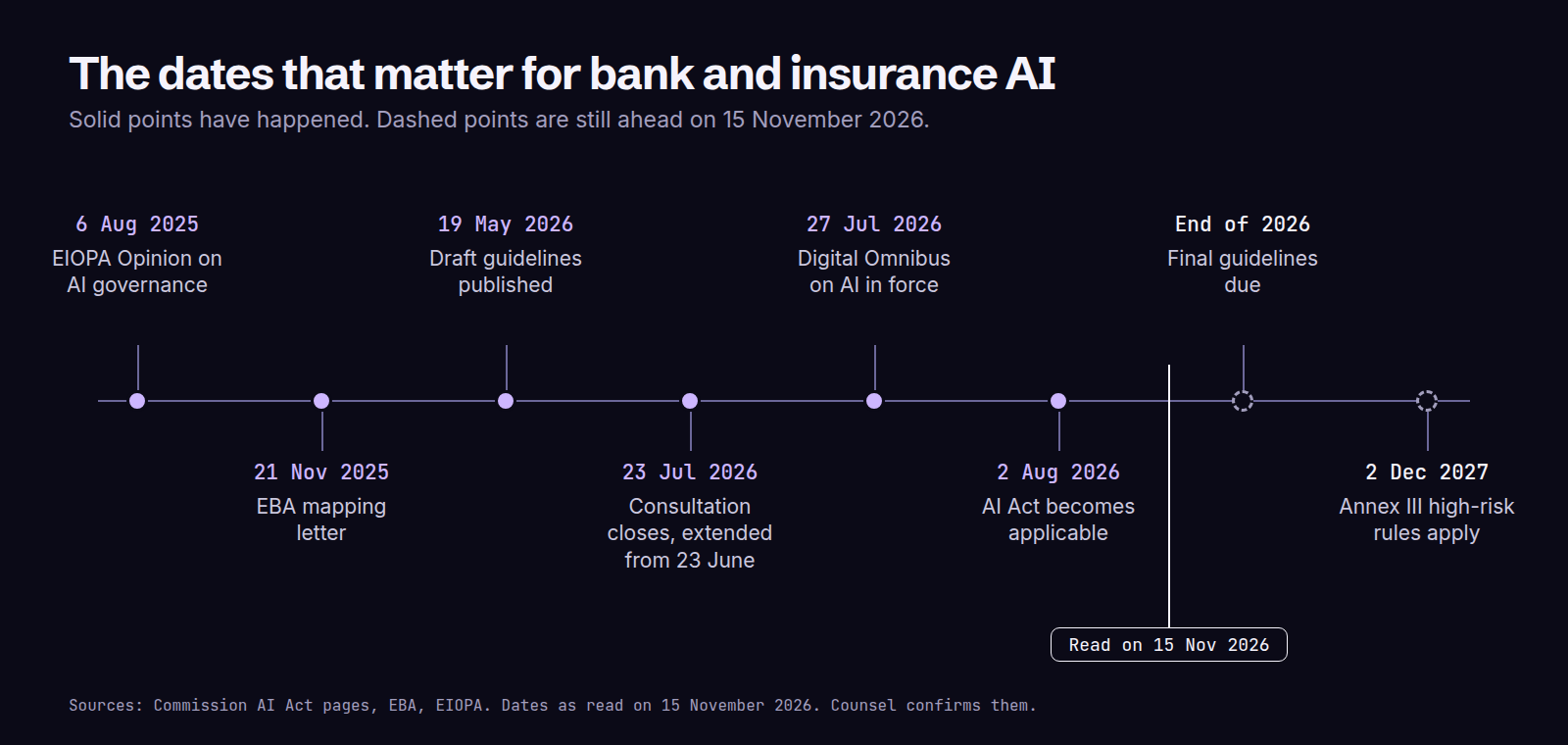
Dates that matter, as read on 15 November 2026.
A system already in use stays outside the high-risk rules only while its design does not change significantly. Under Article 111(2), a high-risk system placed on the market or put into service before the date of application is covered only if, from that date, it is subject to significant changes in its design. The draft guidelines repeat that for high-risk systems used by financial institutions. What counts as significant is a question for counsel.
Our rule of thumb is to re-run the five questions when one of these happens:
- the final guidelines are published, due by the end of 2026;
- an agent gets a new output, such as a score, a rank or a recommendation about a person;
- two uses share one model, for example fraud flags and underwriting;
- the sales page or instructions describe a new use;
- a new product enters scope, such as long-term care or credit life cover;
- you buy or build a replacement model.
How do we handle this at Wise Agents?
For each process, we write the classification and its reasons into the brief, and your counsel reviews it. Here are the agents on our public pages, with the row of the table each one sits in (our reading, for counsel to confirm):
- Claims intake, for insurers: not listed (claims handling). The agent reads the claim and attachments, checks cover against the policy wording, asks for what is missing and drafts a payout proposal with its sources. A claims handler approves every payment or refusal.
- Complaints, for insurers: not listed (complaints after a decision). The agent registers and classifies the complaint, gathers the file and drafts a reply, with the deadline on every draft. A complaints handler decides and sends every reply.
- Coverage answers, for insurers: not listed (no risk assessment or pricing of a person). The agent answers from approved wording, and advice and exceptions go to your licensed staff.
- KYC files and alerts, for banks: not listed while they do not evaluate creditworthiness (the AML row). An analyst accepts, asks for more or refuses each KYC file. An investigator closes or escalates each alert.
- Customer questions, for banks: not high-risk (the chatbot row). The agent answers from your approved terms and FAQs, in the customer’s language, says it is an AI and hands over to a person.
None of our agents prices or assesses a person for life or health cover outside a full high-risk program. You can read more about AI agents for insurance.
Whatever the verdict, keep the reasons in writing. Article 6(4) makes the provider document them when it relies on the filter. As a deployer, ask for that assessment: the draft guidelines encourage deployers to verify the use of the exception in the EU database.
Bring one process. In 45 minutes you get a first view of its risk class, the controls it needs and whether an agent is the right tool at all. Book a scoping call.
Questions
Is a claims agent high-risk under the AI Act?
Usually not. The Commission's draft guidelines put claims management in health insurance outside Annex III point 5(c), because verifying a claim or setting the amount to pay is distinct from risk assessment or pricing. In our reading, it becomes high-risk if the same system also assesses or prices a person's life or health risk.
Is insurance fraud detection high-risk under the AI Act?
It depends on the design. Point 5(c) has no fraud-detection exception, unlike point 5(b) for credit. A life or health risk system is high-risk even if it also has a fraud feature. Only a fraud feature that is a distinct system in its own right falls outside point 5(c), per the draft guidelines.
Are motor and home insurance AI systems high-risk?
Not under Annex III point 5(c). The draft guidelines say other insurance services, such as motor and home, are not covered. Other rules still apply, including GDPR, the AI Act's transparency duty for chatbots, and EIOPA's Opinion on AI governance.
Does a human sign-off make a credit scoring agent not high-risk?
No. The draft guidelines say human involvement has no effect on classification under Article 6(2). Human oversight is a requirement for high-risk systems, not a way out. Only the Article 6(3) conditions can exempt an Annex III system, and a system that profiles people cannot use them.
When do the high-risk rules apply to banks and insurers?
From 2 December 2027 for Annex III systems, per Article 113 as amended by the Digital Omnibus on AI, which entered into force on 27 July 2026. We read the text on 15 November 2026. Confirm the dates with your counsel.
Sources
- ai-act-service-desk.ec.europa.euai-act-service-desk.ec.europa.eu/en/ai-act/annex-3
- ai-act-service-desk.ec.europa.euai-act-service-desk.ec.europa.eu/en/ai-act/article-6
- ai-act-service-desk.ec.europa.euai-act-service-desk.ec.europa.eu/en/ai-act/article-26
- ai-act-service-desk.ec.europa.euai-act-service-desk.ec.europa.eu/en/ai-act/article-27
- ai-act-service-desk.ec.europa.euai-act-service-desk.ec.europa.eu/en/ai-act/article-43
- ai-act-service-desk.ec.europa.euai-act-service-desk.ec.europa.eu/en/ai-act/article-49
- ai-act-service-desk.ec.europa.euai-act-service-desk.ec.europa.eu/en/ai-act/article-50
- ai-act-service-desk.ec.europa.euai-act-service-desk.ec.europa.eu/en/ai-act/article-86
- ai-act-service-desk.ec.europa.euai-act-service-desk.ec.europa.eu/en/ai-act/article-99
- ai-act-service-desk.ec.europa.euai-act-service-desk.ec.europa.eu/en/ai-act/article-111
- ai-act-service-desk.ec.europa.euai-act-service-desk.ec.europa.eu/en/ai-act/article-113
- ai-act-service-desk.ec.europa.euai-act-service-desk.ec.europa.eu/en/ai-act/recital-53
- digital-strategy.ec.europa.eudigital-strategy.ec.europa.eu/en/library/draft-commission-guidelines-classification-high-risk-ai-systems
- ec.europa.euec.europa.eu/newsroom/dae/redirection/document/128561
- ec.europa.euec.europa.eu/newsroom/dae/redirection/document/128559
- digital-strategy.ec.europa.eudigital-strategy.ec.europa.eu/en/news/consultation-guidelines-high-risk
- digital-strategy.ec.europa.eudigital-strategy.ec.europa.eu/en/news/ai-omnibus-enters-force
- digital-strategy.ec.europa.eudigital-strategy.ec.europa.eu/en/policies/regulatory-framework-ai
- www.eba.europa.euwww.eba.europa.eu/sites/default/files/2025-11/2019d1b5-59f8-4149-ad3b-23cfcd4388a1/EBA%20Chair%20letter%20to%20Mr%20Berrigan%20and%20Mr%20Viola%20on%20outcome%20of%20EBA%E2%80%99s%20AI%20Act%20mapping%20exercise.pdf
- www.eba.europa.euwww.eba.europa.eu/sites/default/files/2025-11/d8b999ce-a1d9-4964-9606-971bbc2aaf89/AI%20Act%20implications%20for%20the%20EU%20banking%20sector.pdf
- www.eiopa.europa.euwww.eiopa.europa.eu/eiopa-publishes-opinion-ai-governance-and-risk-management-2025-08-06_en
- www.hunton.comwww.hunton.com/privacy-and-cybersecurity-law-blog/european-commission-releases-draft-guidelines-on-high-risk-ai-under-the-eu-ai-act
- gdpr-info.eugdpr-info.eu/art-22-gdpr/
Read on or before 15 November 2026. Not legal advice: your counsel and data protection officer decide.
Related posts

AI Agent Audit Logs: What to Record and How Long to Keep It
AI agent audit logs: the fields to record for every run, what AI Act Articles 12, 19 and 26(6) and GDPR say about keeping them, and a review routine.
Read
AI Literacy Training: What Article 4 Asks, and a Staff Plan
AI literacy under Article 4 now means supporting it, not guaranteeing it. What changed, who enforces it, and a training plan by role for 200 people.
Read
Fundamental Rights Impact Assessment (FRIA): Who Needs One
Fundamental rights impact assessment AI Act guide: who must do a FRIA, when, what the six elements are and how to build it on your DPIA. Read 15 Nov 2026.
Read