
A client’s due-diligence questionnaire lands on the desk of a head of HR at a 200-person insurance broker (a typical situation, not a client). One line asks how the firm makes sure its staff understand the AI tools they use. The firm has one AI assistant switched on for most people, a claims team trying an agent, and no training records at all.
That line is a question about AI literacy, and since the Digital Omnibus on AI rewrote Article 4 it has a clearer answer. AI literacy under the AI Act is a duty to take measures that help your staff, and the other people who work with AI for you, understand the AI they use. It is a duty of effort: you do not have to guarantee any level of AI literacy for any individual, and the Commission says you need no certificate. You do have to act, to fit the action to each person’s role and tools, and to be able to show what you did.
We read the Regulation, the Commission’s AI literacy Q&A (last updated 20 October 2026) and the German regulator’s guidance on 15 November 2026. This is an engineer’s reading of the text, written for the people who will ask their counsel to confirm it. It is not legal advice.
What is AI literacy under the AI Act?
The Act defines it in Article 3(56): “skills, knowledge and understanding that allow providers, deployers and affected persons, taking into account their respective rights and obligations in the context of this Regulation, to make an informed deployment of AI systems, as well as to gain awareness about the opportunities and risks of AI and possible harm it can cause.”
Recital 20 makes that concrete. The notions people need “may vary with regard to the relevant context” and can include the correct application of technical elements, the measures to apply during use, and “the suitable ways in which to interpret the AI system’s output”. In plain words, AI literacy is knowing what the AI in front of you can and cannot do, and what to do about it. It is not a coding skill.
The Commission’s AI literacy Q&A gives a plain example. Asked whether a company whose staff use ChatGPT to write advertisement text or translate needs to meet the requirement, it answers: “Yes, they should be informed about the specific risks, for example hallucination.”
The numbers explain why this matters beyond the law. In 2025, 19.95% of EU enterprises used AI technologies, and 30.36% of medium enterprises did, according to Eurostat. Among enterprises that had ever considered using AI, the most common reason for not using it was a lack of relevant expertise (70.89%). The people problem comes before the technology problem.
What did Article 4 say before, and what does it say now?
The original text asked providers and deployers to “take measures to ensure, to their best extent, a sufficient level of AI literacy” of their staff and other persons. A CMS legal update written while the rule was still ahead of us quotes it. The Digital Omnibus on AI replaced the article. The Omnibus has been in force since 27 July 2026, according to the AI Act Explorer, and the Commission’s service desk now shows the amended text.
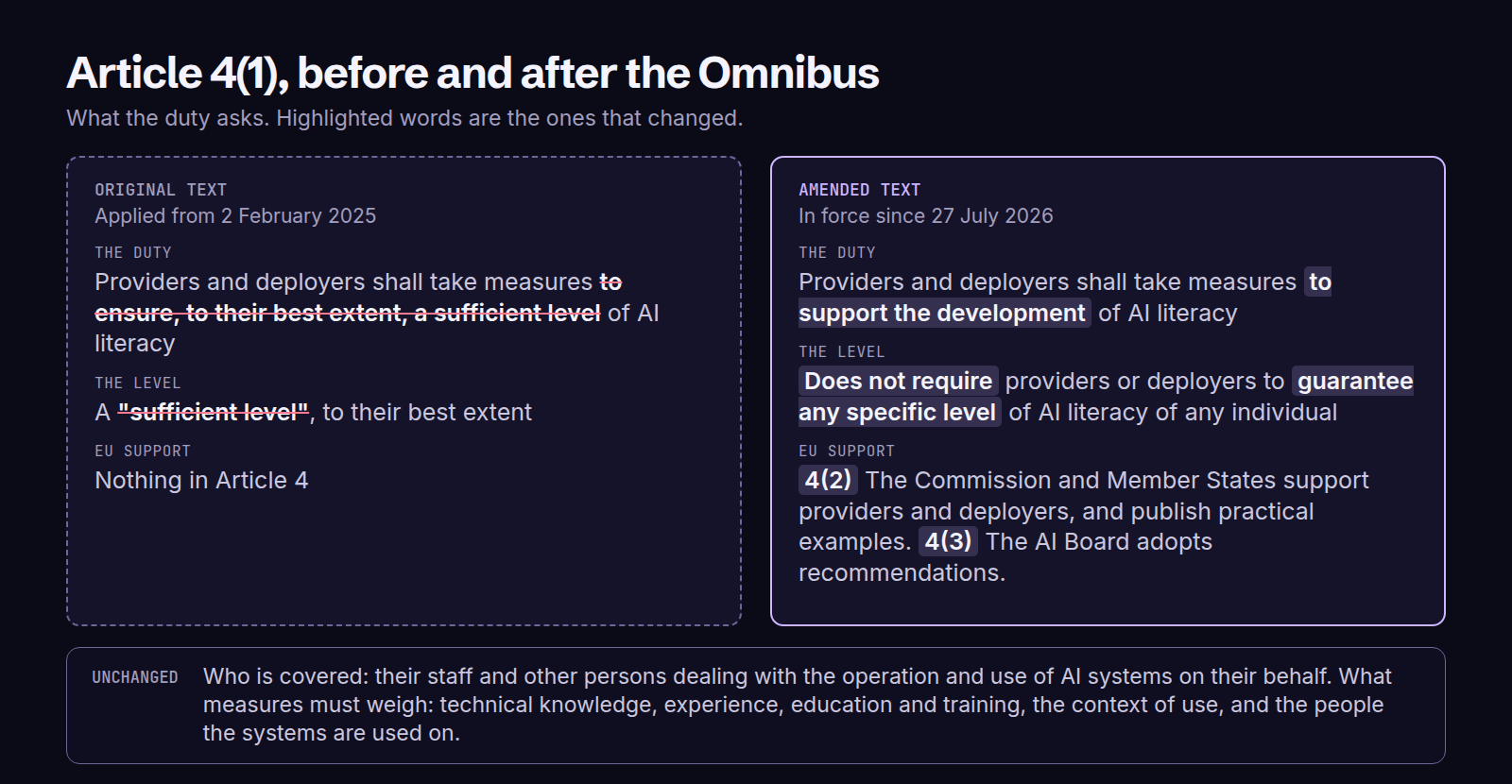
Article 4(1) before and after the Omnibus. The people covered and the factors to weigh are unchanged. The verb and the level are what moved.
The Commission describes the change as a simplification, with the Commission and the Member States taking a stronger role in promoting AI literacy. Four things changed:
- The verb. “Ensure, to their best extent, a sufficient level” became “take measures to support the development of AI literacy”.
- A written limit. The new text adds: “This obligation does not require providers or deployers to guarantee any specific level of AI literacy of any individual.”
- Support from the EU side. Article 4(2) says the Commission and the Member States “shall support and facilitate” the efforts of providers and deployers, in particular SMEs. The Commission shall also publish practical examples of how to comply on the single information platform.
- Recommendations. Article 4(3) has the AI Board adopt recommendations, “taking into account European competence frameworks”, including common objectives.
What did not change: the people covered (“their staff and other persons dealing with the operation and use of AI systems on their behalf”). The factors your measures must weigh did not change either: each person’s technical knowledge, experience, education and training, the context of use, and the people the systems are used on. Modulos sets the two versions side by side and marks both rows “unchanged”.
The reason is in the Omnibus’s own recital 8, as the AI Act Explorer prints it. The recital cites the experience of stakeholders, who found that stringent obligations to ensure a sufficient level “would not be suitable for all types of providers and deployers”. It adds that “data indicates” such obligations create “an additional compliance burden, particularly for smaller enterprises”, and it says AI literacy “should be a strategic priority, regardless of regulatory obligations and potential sanctions.”
Our reading: the Omnibus lowered the bar for the outcome and left the work in place. Nobody can fail Article 4 because one employee scored badly on a quiz. A company can still fall short by doing nothing, or by doing the same thing for everyone.
A practical warning follows. Pages written before July 2026 describe the old duty, and some are still online. If a page tells you to bring every employee to a “sufficient level”, check its date.
One thing is still open. When we read it on 15 November 2026, the Commission’s Q&A (updated 20 October 2026) described the examples of how to comply as something the Commission “will publish”, and the AI Board’s recommendations as something the Board “should” adopt.
Who has to train whom?
The duty falls on providers and deployers of AI systems. A provider develops an AI system or has one developed and puts it into service under its own name. A deployer is anyone “using an AI system under its authority except where the AI system is used in the course of a personal non-professional activity” (Article 3(3) and (4), same definitions page). A broker that gives staff an AI assistant is a deployer. So is a bank that runs a scoring model.
| Group | Covered by Article 4? | What the sources say |
|---|---|---|
| Your employees who work with AI | Yes | The Q&A says it concerns “anyone in the organisation directly dealing with an AI system” |
| Contractors and service providers | Yes | “Persons dealing with the operation and use of AI systems on behalf of providers/deployers” are “not employees, but persons broadly under the organisational remit” |
| Your clients | Only if they deal with your AI systems on your behalf | The Q&A names “a client” among the persons under the organization’s remit, and says it “can be useful to have literacy as well for customers/clients”, depending on the risk |
| A company outside the EU | Yes, if the system is used in the EU | The Q&A: the Act applies when the system is placed on the Union market, used in the Union or “its use has an impact on people located in the EU” |
| Staff with an AI degree | Not automatically | “Normally yes, but it depends on the AI tool in question and their specific qualification” |
Article 4 covers every AI system in scope, not only high-risk ones. The Commission’s Q&A also says the AI Office imposes no sector-specific requirements: the sector and the purpose matter as context for what you teach.
Is the AI literacy requirement enforced, and can you be fined?
Yes to the first, and it depends on where you operate for the second. The Commission’s Q&A says Article 4 “entered into application on 2 February 2025”. It adds that “the supervision and enforcement rules apply from 2 August 2026 onwards.” The Commission’s AI literacy page says the national authorities start supervising and enforcing Article 4 on that date. The authority is national, not the AI Office: “the supervision and enforcement of Article 4 of the AI Act is not with the AI Office, but it is under the remit of national market surveillance authorities.”
Penalties are set country by country. The structure is:
- No EU fine tier names Article 4. Article 99(4) sets fines of up to EUR 15 000 000 or, for an undertaking, up to 3% of total worldwide annual turnover, whichever is higher. It lists provider duties under Article 16, deployer duties under Article 26 and the transparency duties of Article 50, among others. Article 4 is not on the list, and MuchSkills and Modulos reach the same reading.
- Member States still set rules. Article 99(1) has each Member State lay down “the rules on penalties and other enforcement measures” for “any infringement of this Regulation by operators”. The Commission’s Q&A says national authorities “could impose penalties and other enforcement measures to sanction infringements of Article 4”, based on national laws.
- Proportionality applies. Any sanction “must be proportionate, based on the individual case”. The Q&A says it “might, however, be more likely if there is proof of an incident due to lack of appropriate training and guidance of employees or other persons.”
- No criminal offence, no new right to damages. “The AI Act doesn’t create criminal offences or a right to compensation.” If harm occurs, a claim would go through national law.
Two further points shape how you plan. Article 99(7)(g) tells an authority setting a fine to consider “the technical and organisational measures implemented” by the operator, so a record of training is the kind of evidence that can help you if something else goes wrong.
And for people who oversee high-risk systems, a separate and fineable duty applies. Article 26(2) says deployers “shall assign human oversight to natural persons who have the necessary competence, training and authority, as well as the necessary support”. Article 99(4)(e) covers deployer obligations under Article 26. For Annex III systems, that applies from 2 December 2027 (Article 113). The Commission’s Q&A is explicit that the obligation to train oversight staff “remains in place” after the Omnibus.
An example of the national layer: Germany’s KI-MIG. LTO’s analysis of it says the Bundesnetzagentur is the default market surveillance authority, while market surveillance of AI systems directly tied to a regulated financial activity is in principle assigned to BaFin. A bank or insurer should ask which authority will look at its file, not assume.
Our planning rule: the fine is the least likely cost and the incident is the real one. The question that follows an incident is what the person involved had been taught about the system they used. A client’s questionnaire may ask it sooner.
What should AI literacy for employees cover?
The Commission’s Q&A names the minimum. It says providers and deployers “should consider at least the following steps and questions”:
| Commission step | Question to answer | What to write down | Who answers it |
|---|---|---|---|
| 1. A general understanding of AI | What is AI, how does it work, what AI do we use, and what are its opportunities and dangers? | A list of the AI systems and features in use, one line each | IT and process owners |
| 2. Your role | Are we developing AI systems, or just using systems others developed? | Provider or deployer, per system | Compliance |
| 3. The risk of the systems | What do people need to know when dealing with each system, and which risks and mitigations should they be aware of? | Per system: the main ways it fails, and its risk class if you have classified it | Risk, with the process owner |
| 4. Measures built on that analysis | How much do people already know, what else should they know, and who are the systems used on? | The role map: group, current knowledge, gap, module | HR or L&D, with managers |
We turned the four steps into a worksheet. The first two columns follow the Commission’s wording, and the last two are our suggestion.
The Q&A adds that these steps “include legal and ethical aspects”, so a link to the AI Act and to ethics and governance is encouraged. It also lifts three burdens people often assume. You do not have to test staff knowledge (“Article 4 of the AI Act does not entail an obligation to measure the knowledge of AI of employees”). You do not need a governance board (“no specific governance structure is mandated”). And no format is fixed (“no strict requirements or mandatory trainings are imposed”).
The Bundesnetzagentur, Germany’s regulator, turns this into three cornerstones: identify needs, design measures, and keep records, evaluate and update. It also suggests content in three stages. Stage 1 is a basic understanding of data and AI. Stage 2 is advanced AI literacy, including the organization’s role in the value chain and the legal classification of the AI it uses. Stage 3 is role-specific training with technical, legal or ethical focal points. Its page says the content is “neither binding nor exhaustive”.
One more thing the Commission is blunt about: “in many cases, simply relying on the AI systems’ instructions for use or asking the staff to read them might be ineffective.”
How should AI literacy differ by role?
Every factor in Article 4(1) varies with the job, so the content has to as well. We use four layers.
| Layer | Who | What they need to be able to do |
|---|---|---|
| Baseline | Everyone | Say what AI is, what it gets wrong, what data must not go into a prompt, and who to ask |
| Tools in daily work | People who use an AI assistant or AI feature | Check output on their own tasks, spot a confident wrong answer, know the firm’s rules for each tool |
| Agent oversight | People who review, approve or override an AI system’s output | Know what this system does well, where it failed in testing, its typical mistakes, and when to send a case back |
| Build, buy and govern | IT, data, procurement, risk, compliance, DPO, executives | Classify systems, ask vendors the right questions, keep the inventory, own the program |
Two pieces of evidence argue for training on the specific system, not on AI in general.
The first is the “jagged technological frontier” experiment, published as a Harvard Business School working paper and run with Boston Consulting Group. In the abstract, 758 knowledge workers were randomly assigned to no AI access, GPT-4 access, or GPT-4 access with a prompt engineering overview. On 18 tasks inside the frontier of AI capabilities, those using AI completed 12.2% more tasks and finished them 25.1% faster on average. On “a complex managerial task selected to be outside the frontier, subjects using AI were 19% less likely to produce correct solutions compared with those without AI.” The lesson for training: a person has to learn where the tool fails on their own work, not just how the tool works.
The second is in the AI Act. Article 14(4)(b) says the people assigned to oversee a high-risk system must be enabled “to remain aware of the possible tendency of automatically relying or over-relying on the output produced by a high-risk AI system (automation bias)”. Reviewers who have never seen the system fail will not catch it failing. We make the same point in our post on human oversight in practice: train reviewers on the agent, and an hour with the test report teaches more than a general course on AI.
If you use a high-risk system in the workplace, Article 26(7) adds a duty to inform workers’ representatives and the affected workers before you put it into service.
What does an AI literacy training plan for 200 people look like?
The Act sets no hours, so the numbers below are our example for a 200-person firm that uses an AI assistant widely and has one or two agents in testing. Replace them with your own inventory. Everyone gets a baseline. Most people also get a workshop on the tools they use. Smaller groups get role modules.
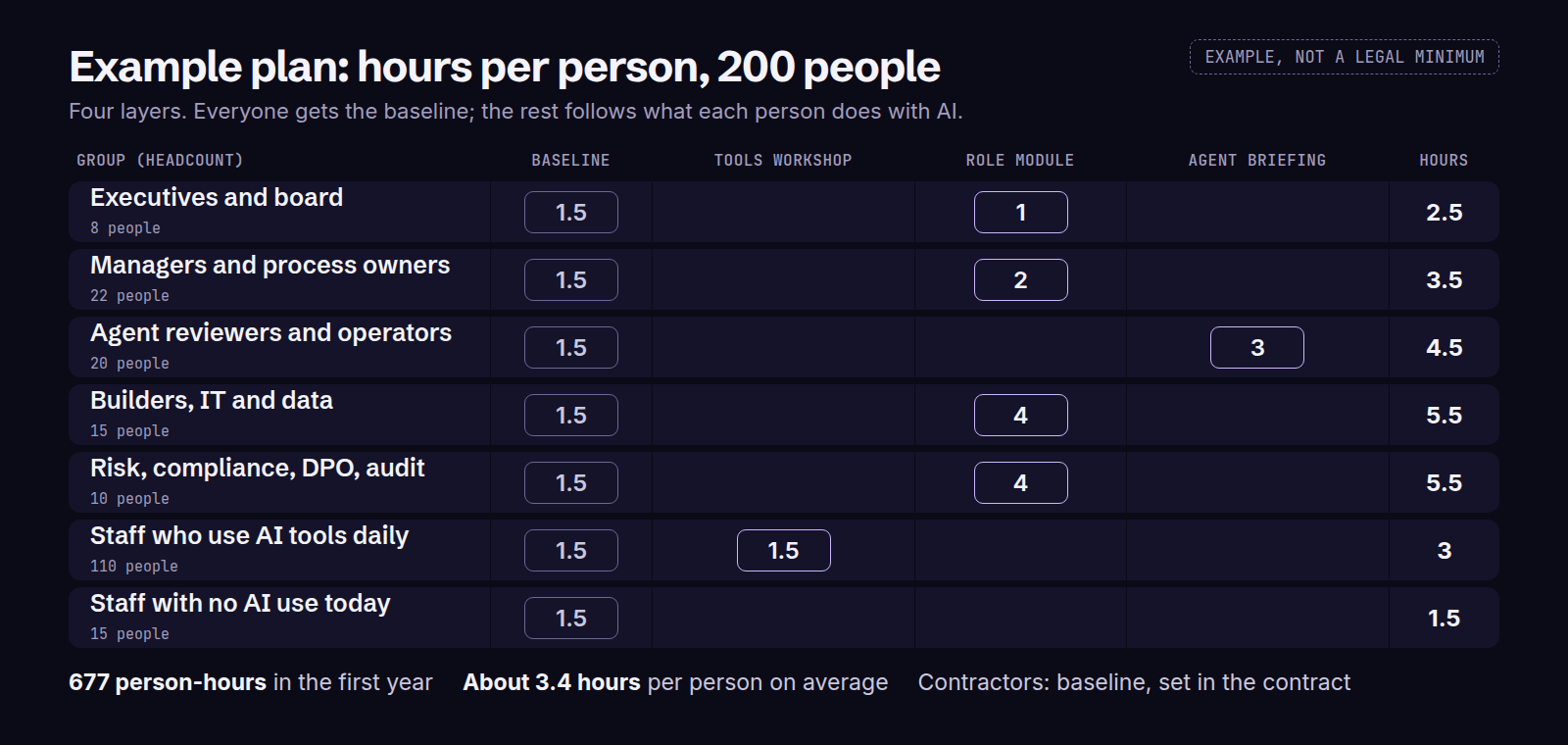
Example plan for 200 people. Hours are an illustration, not a legal minimum. Groups are exclusive, so the headcounts add up to 200.
| Group | Example headcount | What they learn | Example time per person |
|---|---|---|---|
| Executives and board | 8 | Where AI is used, which decisions it touches, what Article 4 and Article 26 ask, what to ask the vendor | 1 hour plus the baseline |
| Managers and process owners | 22 | How to decide which tasks go to AI, how output is reviewed, the rules for each tool | 2 hours plus the baseline |
| Agent reviewers and operators | 20 | The specific agent: its test results, typical mistakes, when to send a case back, how to log an override | 3 hours plus the baseline |
| Builders, IT and data | 15 | Permissions, data paths, vendor changes, how to test a system and keep its record | 4 hours plus the baseline |
| Risk, compliance, DPO, audit | 10 | The inventory, classification, the evidence file, how to answer a client’s questionnaire | 4 hours plus the baseline |
| Staff who use AI assistants in daily work | 110 | Their tools on their own tasks: checking output, data in prompts, when to escalate | 1.5 hours plus the baseline |
| Staff with no AI use at work today | 15 | The baseline only | The baseline |
| Baseline for everyone | 200 | What AI is, how it fails, what data stays out of prompts, who to ask | 1.5 hours |
In this example the baseline is 300 person-hours (200 people at 1.5 hours), and the role modules add 377, for about 677 hours in the first year, or roughly 3.4 hours per person. Contractors who work with your AI tools are on top: cover them in the contract and give them the baseline.
Others start with the whole workforce too. The Commission’s repository of AI literacy practices describes Alteryx “providing AI resources to the whole workforce while directing role-based training to individual employees”, and Assicurazioni Generali running a global digital upskilling program for all of its employees. The repository holds more than 40 initiatives, and the Commission is clear that copying one “does not automatically grant presumption of compliance with Article 4”.
A rollout order that works for a firm this size (our example):
- Weeks 1 and 2: take the inventory. List every AI system or feature in use, including ones a vendor switched on in an update. For each: what it does, who uses it, what decision it touches, and whether you are provider or deployer. It covers steps 1 to 3 of the Commission’s list above, and nothing else can be sized without it.
- Week 3: assign people to groups. Use what each person does with AI output, not their job title.
- Weeks 3 to 6: deliver in order. Baseline first, then the tool workshops, then the role modules. Put reviewer briefings just before an agent goes live.
- From day one: record each session (the template is below).
- Every year and at every trigger: refresh. A new tool, a new use of an old tool, an incident, or a significant change to a system each send a group back through the relevant module.
What evidence of AI literacy should you keep?
The Commission answers the certificate question directly: “There is no need for a certificate. Organisations can keep an internal record of trainings and/or other guiding initiatives.” A certificate of completion can still be a convenient part of the record. Modulos says passing its course quiz produces one “that your organization can keep with its training records”. The record is the evidence, and the certificate is one page of it.
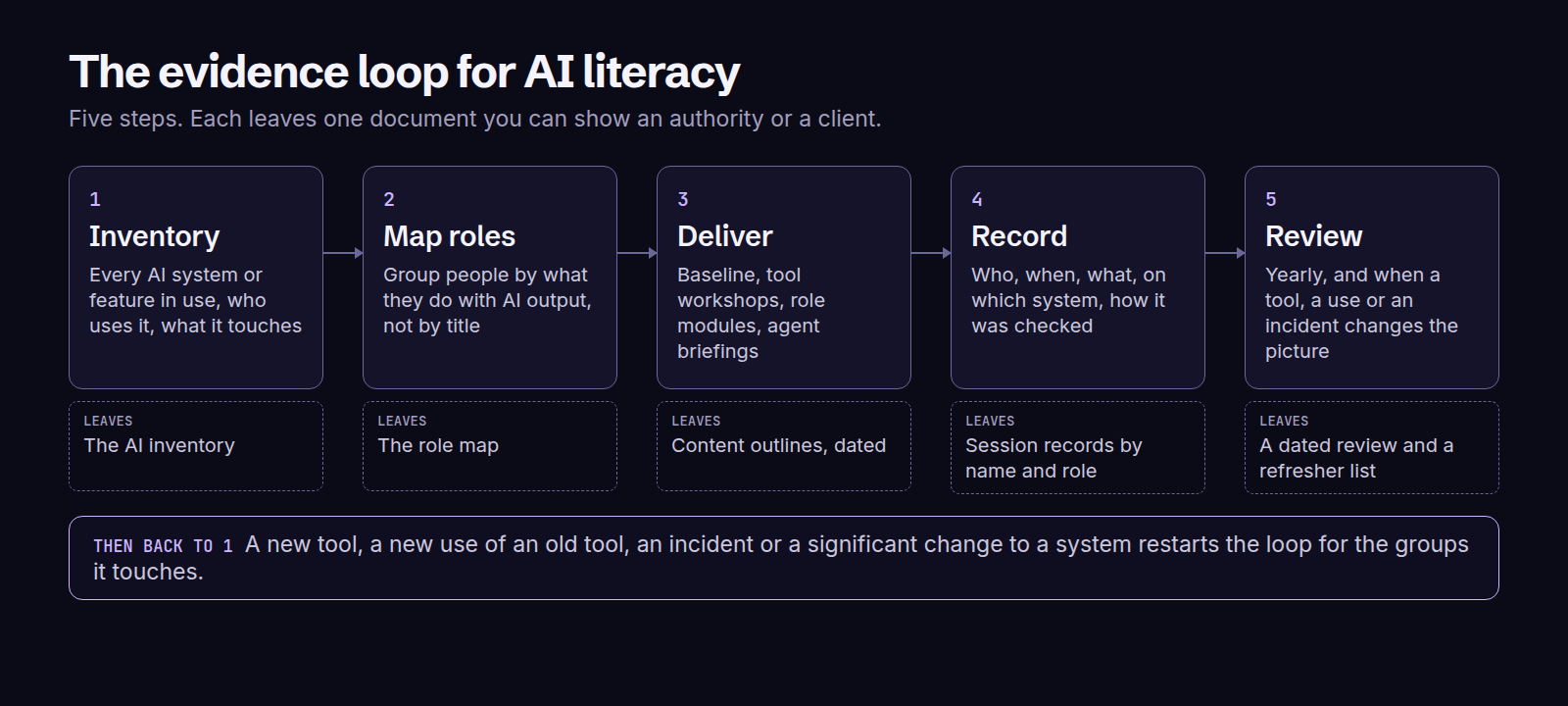
The evidence loop. Each step leaves one document you can hand to an authority or a client.
The Bundesnetzagentur says what an adequate record holds: “the type of measures, their scope in terms of content and duration, and the persons taking part”. It also asks for regular evaluation and refresher training “tailored to specific needs, e.g., because AI systems or the context of use may change over time”. A training vendor, Learnsignal, adds practical detail on the record: attendance “by name and role, not a headcount”. We agree, and we would add the systems covered, because that ties a person to the inventory.
A record template you can copy into a spreadsheet:
date, session title, content summary (link), format, delivered by, person, role, AI systems covered, how it was checked, refresher due
2026-12-03, Reviewer briefing: claims triage agent, link to the agenda, live 2 hours, Head of Claims, A. Example, claims reviewer, claims triage agent, 6 practice cases, 2027-12
That second row is an example of the shape, not a real record. Keep the inventory, the role map, the content outlines and the session records together, and date every version. The test of a good record is simple: could someone who was not in the room tell, a year later, who learned what about which system?
If you are a bank or an insurer, you may already have the plumbing. DORA’s Article 13(6) requires financial entities to “develop ICT security awareness programmes and digital operational resilience training as compulsory modules in their staff training schemes”, applicable to all employees and senior management. The same tracking can carry the AI literacy record.
Which mistakes sink an AI literacy program?
- One course for everyone. The Commission says there is “no one size fit all” and the Bundesnetzagentur says organizations are free to tailor measures to their systems, tasks and what staff already know. A generic video is a fine baseline and a weak answer for a person deciding about customers.
- Handing out the instructions for use. The Commission calls this “ineffective” in many cases.
- Training with no record. Learnsignal’s phrase for it is blunt: “A folder of completion emails from a generic AI course does not show that you assessed exposure; it shows that some people did a course.”
- A one-off session. The Bundesnetzagentur asks for evaluation and refreshers. Tools change faster than a training calendar.
- Forgetting the people who are not employees. Contractors and service providers are inside the scope.
- Treating a certificate as the goal. It is fine as a record. It is not the duty.
- Keeping Article 4 apart from oversight. If an agent will make or shape decisions about customers, the people who review it need the agent-specific briefing, and for a high-risk system that is a separate duty under Article 26(2).
How do we handle this at Wise Agents?
Our AI Act page lists Article 4 with this method: a briefing for the people who oversee the agent. The production step of our work includes training for your reviewers. Our post on oversight says what that training should cover: what the agent does well, where it failed in testing, its typical mistakes and when to send a case back. The wider program (the baseline, the tool workshops, the records) is yours to run, and this post is written so you can run it without us.
For dates and the other duties around it, see our post on the EU AI Act for companies deploying agents. If your staff put personal data into prompts, the baseline needs a page on that, and our post on GDPR and AI agents is where to start. Before you start, our AI Act risk check screens a process in eight questions.
It is the record we would want to see if we were the one asking. Bring one process. In 45 minutes you get a first view of its risk class, the controls it needs and whether an agent is the right tool at all. Book a scoping call.
Questions
Is AI literacy training mandatory under the EU AI Act?
Article 4 obliges providers and deployers to take measures to support AI literacy, but no specific training is mandatory. The Commission says no strict requirements or mandatory trainings are imposed, and that no certificate is needed. What you do has to fit each person's role, tools and context, and you should be able to show it.
Do we need an AI literacy certificate for our staff?
No. The Commission's Q&A says there is no need for a certificate and that organizations can keep an internal record of trainings and other guiding initiatives. A certificate of completion can be one page of that record. The evidence is the record itself: who learned what, when, about which system.
Can you be fined for not providing AI literacy training?
No EU-level fine tier in Article 99 names Article 4, and penalties are set by each Member State under Article 99(1). National market surveillance authorities have supervised the rules since 2 August 2026. The Commission says a sanction might be more likely if there is proof of an incident due to lack of appropriate training, so check your country's penalty law with counsel.
Does Article 4 apply to contractors and small companies?
It covers staff and other persons who deal with AI systems on your behalf, and the Commission says that can include contractors and service providers. The text of Article 4 has no size exception, and Article 4(2) says the Commission and the Member States shall support providers and deployers, in particular SMEs.
What changed in Article 4 after the Digital Omnibus on AI?
The duty moved from taking measures to ensure, to the best extent, a sufficient level of AI literacy to taking measures to support its development. The text now says providers and deployers do not have to guarantee any specific level for any individual. The Commission and Member States must support the effort, and the AI Board adopts recommendations.
Sources
- ai-act-service-desk.ec.europa.euai-act-service-desk.ec.europa.eu/en/ai-act/article-3
- ai-act-service-desk.ec.europa.euai-act-service-desk.ec.europa.eu/en/ai-act/recital-20
- digital-strategy.ec.europa.eudigital-strategy.ec.europa.eu/en/faqs/ai-literacy-questions-answers
- ec.europa.euec.europa.eu/eurostat/statistics-explained/index.php?title=Use_of_artificial_intelligence_in_enterprises
- cms.lawcms.law/en/aut/legal-updates/compulsory-or-optional-ai-literacy-a-central-component-of-compliance-with-ai-act
- artificialintelligenceact.euartificialintelligenceact.eu/ai-act-explorer/digital-omnibus/
- ai-act-service-desk.ec.europa.euai-act-service-desk.ec.europa.eu/en/ai-act/article-4
- digital-strategy.ec.europa.eudigital-strategy.ec.europa.eu/en/news/ai-omnibus-enters-force
- www.modulos.aiwww.modulos.ai/blog/eu-ai-act-article-4-ai-literacy-training-by-role
- digital-strategy.ec.europa.eudigital-strategy.ec.europa.eu/en/policies/ai-talent-skills-and-literacy
- ai-act-service-desk.ec.europa.euai-act-service-desk.ec.europa.eu/en/ai-act/article-99
- www.muchskills.comwww.muchskills.com/blog/eu-ai-act-article-4-ai-literacy-enforcement
- ai-act-service-desk.ec.europa.euai-act-service-desk.ec.europa.eu/en/ai-act/article-26
- ai-act-service-desk.ec.europa.euai-act-service-desk.ec.europa.eu/en/ai-act/article-113
- www.lto.dewww.lto.de/recht/hintergruende/h/kuenstliche-intelligenz-ai-act-ki-mg-aufsicht-bussgeld/print.html
- bundesnetzagentur.debundesnetzagentur.de/EN/Areas/Digitalisation/AI/07_Literacy/start.html
- www.hbs.eduwww.hbs.edu/faculty/Pages/item.aspx?num=64700
- ai-act-service-desk.ec.europa.euai-act-service-desk.ec.europa.eu/en/ai-act/article-14
- digital-strategy.ec.europa.eudigital-strategy.ec.europa.eu/en/policies/ai-literacy-practices
- www.learnsignal.comwww.learnsignal.com/blog/how-to-evidence-ai-literacy-without-a-certificate/
- eur-lex.europa.eueur-lex.europa.eu/eli/reg/2022/2554/oj
Read on or before 15 November 2026. Not legal advice: your counsel and data protection officer decide.
Related posts

AI Act high risk insurance and banking: which AI is listed?
AI Act high risk insurance and banking rules, process by process: what Annex III lists, what it leaves out, and the date your team should plan against.
Read
AI Agent Audit Logs: What to Record and How Long to Keep It
AI agent audit logs: the fields to record for every run, what AI Act Articles 12, 19 and 26(6) and GDPR say about keeping them, and a review routine.
Read
Fundamental Rights Impact Assessment (FRIA): Who Needs One
Fundamental rights impact assessment AI Act guide: who must do a FRIA, when, what the six elements are and how to build it on your DPIA. Read 15 Nov 2026.
Read