
A typical week on a bank’s procurement team: a draft contract arrives for an AI agent that prepares know-your-customer files, and legal asks one question. Does it carry the DORA clauses? The vendor’s reply is a link to a security page.
A security page is not a contract clause. DORA Article 30 is the list that decides it. Regulation (EU) 2022/2554 says a contract on ICT services must contain at least nine elements, and six more when the service supports a critical or important function. A hosted AI agent is an ICT service, so the list applies to it. Below we read each element for an agent, show what passes down to the model provider when the agent supports a critical or important function, and add what DORA leaves out.
We read the Regulation and its technical standards on 15 November 2026, in the Official Journal texts published by the EU Publications Office. This is an engineer’s reading, not legal advice. Your counsel should confirm it, in particular your entity type and which of your functions are critical or important.
Does DORA Article 30 apply to an AI vendor contract?
It applies when your firm is a financial entity and the agent is an ICT service. Most banks and insurers pass both tests.
Article 2(1) lists the financial entities: credit institutions, payment institutions, e-money institutions, investment firms, insurance and reinsurance undertakings, insurance intermediaries and others. Article 3(21) defines ICT services as “digital and data services provided through ICT systems to one or more internal or external users on an ongoing basis”. The recitals ask for a broad reading and name providers of “software, data analytics services” among those covered. A hosted agent fits. A consumer lender that does not appear on the Article 2(1) list is not a financial entity under DORA, so confirm your entity type before you assume the clauses are required of you.
Two things follow. The financial entity writes the clauses into the contract and stays “fully responsible” for its DORA obligations when it outsources (Article 28(1)(a)). And the agent vendor, as an “ICT third-party service provider”, accepts the clauses and passes some of them down to the model and hosting providers behind it. DORA has applied since 17 January 2025 (Article 64).
Which tier is your agent in: Article 30(2) or 30(3)?
Article 30(2) lists nine elements for every contract on ICT services. Article 30(3) adds six for services that support critical or important functions. Which list you need turns on one decision you make before signing: Article 28(4)(a) requires the financial entity to assess whether the contract covers a service supporting a critical or important function.
Article 3(22) defines such a function as one whose disruption “would materially impair the financial performance of a financial entity, or the soundness or continuity of its services and activities”. A function also counts if its failure would impair continuing compliance with the entity’s authorization or other duties under financial services law. Our practical test: if the agent stopped for a week, or returned wrong results nobody caught, would a regulated activity suffer? An agent that drafts internal meeting notes probably sits in the first tier. An agent that prepares credit decisions, KYC files or claims decisions is more likely to sit in the second. The call is yours, it should be written down, and the register of information must show which contracts support critical or important functions and which do not (Article 28(3)).
When in doubt, ask for the longer list. Adding clauses after the vendor already holds your data is harder than asking now.
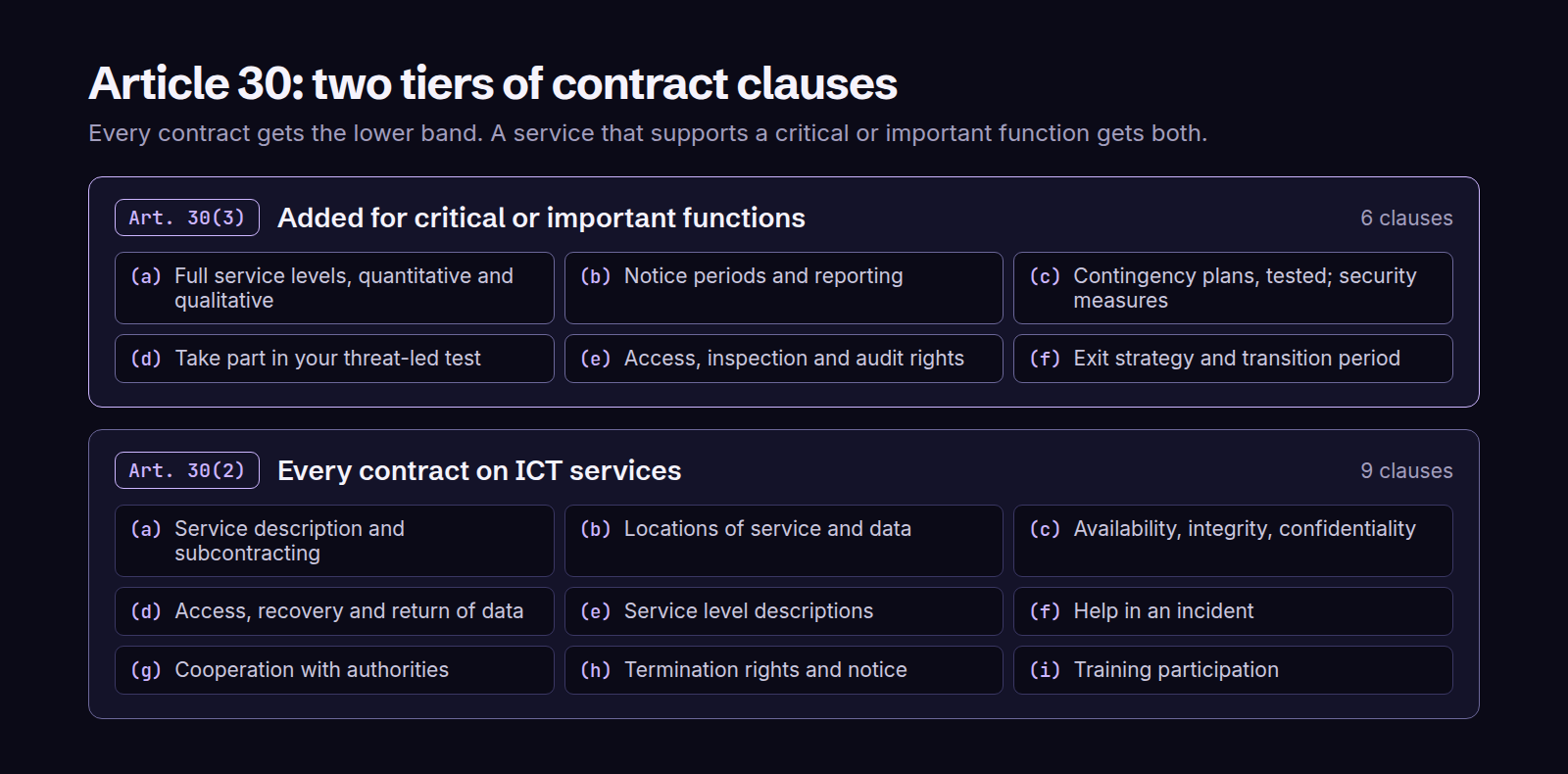
Article 30(2) applies to every contract on ICT services. Article 30(3) adds the second band when the service supports a critical or important function, including the audit rights and the exit strategy.
One caution on checklists: summary pages can blur the two tiers. One we read on 15 November 2026 files provider incident notification, exit and transition, and quantitative performance targets under “all ICT contracts”. In the Regulation those sit in Article 30(3), for critical or important functions. Article 30(2)(f) is narrower: assistance when an incident occurs. Check every checklist against the text.
How does each Article 30 clause read for an AI agent?
The tables follow the Regulation’s lettering. The right-hand column is our reading for an agent: what to ask for so the clause means something.
Article 30(2): every contract on ICT services
| Clause | What the Regulation asks | For an AI agent, ask for |
|---|---|---|
| (a) Description and subcontracting | All functions and ICT services described; whether subcontracting of a critical or important service is permitted, and on what conditions | The agent’s tasks and tools, which actions wait for a person, and the model provider and host named as subcontractors or a rule for adding them |
| (b) Locations | Regions or countries where services are provided and data is processed, storage included; advance notice of a change | Three answers: where the platform runs, where each model call is processed, where logs, indexes and backups sit |
| (c) Data protection | Availability, authenticity, integrity and confidentiality, personal data included | A security schedule that says how clients are separated and how untrusted documents are treated |
| (d) Access, recovery, return | Data returned “in an easily accessible format” on insolvency, resolution, discontinuation or termination | A list of the data (documents, index, test sets, run records, agent specification), each with its format |
| (e) Service levels | Service level descriptions, updates and revisions included | Uptime, plus how a model change counts as a revision |
| (f) Incident assistance | Help at no additional cost, or at a cost fixed in advance | Who investigates a wrong or harmful output, not only an outage |
| (g) Authorities | Full cooperation with competent and resolution authorities | The same duty passed to the model provider |
| (h) Termination | Termination rights and minimum notice periods | Triggers that match Article 28(7), including evidenced weaknesses in the vendor’s ICT risk management |
| (i) Training | Conditions for the provider’s part in your security awareness and resilience training | Which vendor and subcontractor staff take part, and how |
Article 30(3): in addition, for critical or important functions
| Clause | What the Regulation asks | For an AI agent, ask for |
|---|---|---|
| (a) Full service levels | “Precise quantitative and qualitative performance targets”, so you can act “without undue delay” | A pass bar on an agreed test set, not only uptime |
| (b) Notice and reporting | Notice periods and reporting, including any development with material impact on the service | Model retirements, provider outages, subcontractor changes |
| (c) Contingency and security | Business contingency plans implemented and tested; security measures | Evidence of a tested fallback route for the model |
| (d) Testing | Participation in your threat-led penetration test (TLPT) | Whether the agent platform and its model route are in scope |
| (e) Monitoring | Unrestricted access, inspection and audit for you, an appointed third party and the authority; copies on site; cooperation; scope, procedures and frequency | See below |
| (f) Exit | A mandatory adequate transition period during which the provider keeps serving you | A number of days, a price and a data export |
Three of these go wrong more often than the rest.
Locations (30(2)(b)). The Regulation asks for the regions or countries where functions are provided and data is processed, storage included, with advance notice of a change. For an agent that is three questions, not one. A page that says “hosted in Germany” answers the first. The subcontracting standard repeats the point for the model provider and other subcontractors: the contract has to give the location of data they process or store (Delegated Regulation (EU) 2025/532, Article 4(1)(e)).
Audit on a shared platform (30(3)(e)). The right to “unrestricted rights of access, inspection and audit” comes with a pressure valve: the parties may agree “alternative assurance levels if other clients’ rights are affected”, which is the multi-tenant case. The policy standard, Delegated Regulation (EU) 2024/1773, allows pooled audits with other clients in Article 8(2). Article 8(3) adds that the financial entity “shall not over time rely solely on” certifications or audit reports. So “we have a report” does not close the clause, and neither does “no audits”. Ask for scope, frequency, an on-site right and a pooled-audit route, in writing.
Quality targets (30(3)(a)). Uptime is a quantitative target. For an agent, the qualitative one is how often it gets the task right. Write the pass bar and the test set it is measured on into the service-level schedule, and say what happens when a release scores below it. Our guide to oversight design covers the approval step that sits next to that bar.
What must the contract say about the model provider and the chain behind it?
For services supporting critical or important functions, Article 30(5) led to a technical standard: Commission Delegated Regulation (EU) 2025/532, published in the Official Journal on 2 July 2025. It is the part of DORA that reaches the model provider and the cloud behind your agent vendor. Under its Article 4(1), the contract must cover:
- which services may be subcontracted, and under which conditions;
- that the vendor is responsible for what its subcontractors provide, and monitors it;
- the location of data a subcontractor processes or stores;
- that the vendor keeps the service running through the whole chain if a subcontractor fails;
- that the subcontractor grants you and the authorities the same rights of access, inspection and audit as the vendor does;
- that the vendor notifies you of any material change to subcontracting;
- your right to terminate under the standard’s Article 6 or under Article 28(7) of DORA.
Article 5 turns notification into a vote. The vendor must tell you about intended material changes “well in time”. The contract sets a reasonable notice period for you to approve or object, and the vendor “shall only implement” the change after you approve, or do not object by the end of that period. If it goes ahead anyway, or subcontracts a critical service the contract did not permit, Article 6 lets you provide for termination. For an agent, we would treat three changes as material: a new model provider, a new host, and a new logging or evaluation vendor that sees your data. Say so in the clause instead of leaving the term to argument.
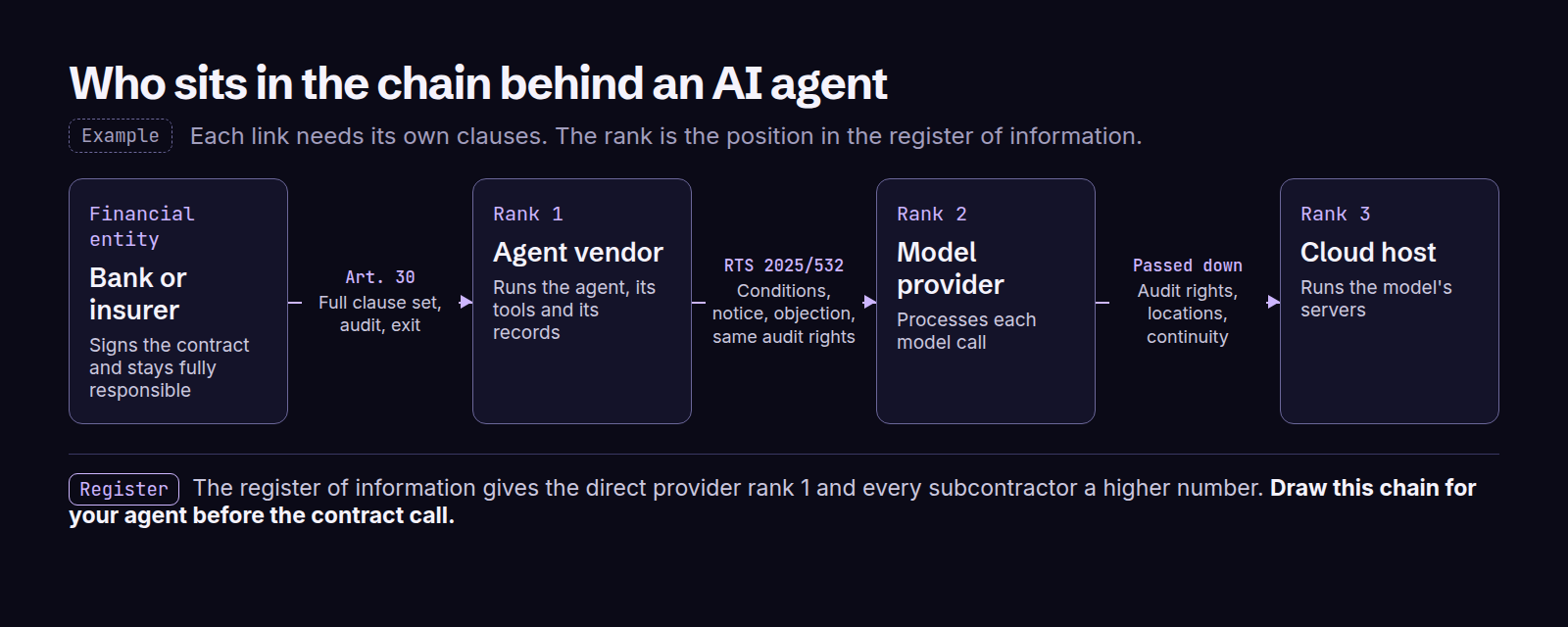
Example chain. Ranks follow the register of information: the vendor that signs with the bank is rank 1, and every subcontractor has a higher number.
The same chain goes into your register of information (Article 28(3)), where each provider gets a rank. Under Implementing Regulation (EU) 2024/2956, Article 2, the direct provider’s rank “shall always be” 1, and a subcontractor’s rank “shall always be higher than” 1. Drawing the chain for the agent before the contract call shows who must be named, in which order, and where the notice clause has to bite.
A word on who is watched directly. On 18 November 2025 the European Supervisory Authorities (EBA, EIOPA and ESMA) published the first list of designated critical ICT third-party providers: 19 names, among them cloud, data center, telecom, IT services and data firms. OpenAI, Anthropic and Mistral AI are not on it. Designation brings a provider under direct supervisory oversight, but your own duties stay yours (Article 28(1)(a)), and with a provider that is not designated the contract is your main lever.
What does DORA not say that an AI contract needs?
DORA is technology-neutral. Four items are not in Article 30, and they are what we would add for an agent. Each rests on a source.
1. Notice before a model is retired or replaced. Model providers retire models on a schedule. Anthropic says it gives at least 60 days’ notice before retiring a publicly released model. OpenAI gives at least six months for generally available models and at least three for specialized variants and image models. Early-access (beta) models can be retired with much shorter notice, such as two weeks. Your vendor sits downstream of those clocks. A version change inside the same provider is not obviously a subcontractor change, so do not count on the notice in the subcontracting standard to catch it. Write in a notice period that leaves you time to re-test, and the new model’s results on your test set before the cut-over.
2. Test results as a deliverable. Tie Article 30(3)(a) to evidence: the vendor shares the results of each release test against the pass bar, with the safety cases. We build our agents this way. Each version runs the client’s test set and a safety pack, and a person approves the release on a card that shows the score, the safety cases and what changed.
3. Run records: who holds them, how long, in what format. The agent’s run records are your evidence for incidents, audits and complaints. Article 30(2)(d) covers returning data, so name the run records in that list. If the agent is a high-risk system under the AI Act, Article 26(6) also applies. Deployers keep the logs the system generates “to the extent such logs are under their control”. A deployer that is a financial institution “shall maintain the logs as part of the documentation kept pursuant to the relevant Union financial service law”. One log can serve both laws, but only if the contract puts it under your control with a retention period. Our AI Act guide for deployers explains when an agent is high-risk.
4. No training on your data, and retention at every link. Article 30(2)(c) covers confidentiality, not whether your prompts train a model. GDPR Article 28(3)(a) requires the processor to act “only on documented instructions”, and our GDPR guide covers the full set of processor clauses. Put into the contract: no training on your data by the vendor or any subcontractor, and the retention period at each link. Check the subcontractor’s own terms. OpenAI’s documentation says data sent to its API is not used to train its models unless you opt in. It also says abuse-monitoring logs, which may hold prompts and responses, are kept for up to 30 days by default. Retention can be longer where the law requires it or to prevent harm. Eligible customers can have their content excluded through zero data retention or modified abuse monitoring. Your vendor’s answer should be at least that clear.
Supervisors are watching the same ground. In a statement dated 31 July 2026 on frontier AI models, the three European Supervisory Authorities encouraged financial entities to keep up-to-date inventories of their IT assets, AI and machine-learning components included. They also offered examples of measures to consider “also in their dialogue with ICT third-party service providers”. A law firm’s summary expects financial entities to put more detailed questions to AI providers, including on their dependency on subcontractors. The contract is where those answers get fixed.
How do you test an exit plan for an AI agent?
Article 28(8) requires exit strategies for ICT services that support critical or important functions. The plans must be “comprehensive, documented” and “sufficiently tested and reviewed periodically”, and you must be able to leave without disrupting your business, limiting regulatory compliance or harming the continuity and quality of service to clients. The policy standard lists three scenarios for the exit plan: unforeseen and persistent service interruptions, inappropriate or failed service delivery, and unexpected termination (Delegated Regulation (EU) 2024/1773, Article 10). It asks for a plan that is “realistic, feasible, based on plausible scenarios”, with a schedule compatible with the exit terms in the contract.
The contract side is Article 30(3)(f): a mandatory adequate transition period during which the provider keeps serving you, so you can move to another provider or bring the service in-house. A swap test shows whether that period is long enough.
- Name the fallback for each of the three scenarios: another model route, a second vendor or an in-house build.
- Keep your own copies of what the agent is built from: its specification and prompts, tool definitions, knowledge sources and test set.
- Run the test set on the fallback and compare with the pass bar. Prompts tuned to one model often behave differently on another, so a pass on the old model proves nothing about the new one.
- Ask for a full export of your data and run records in the format the contract names, and open it with tools you control.
- Time the whole swap, from the decision to the fallback running at the pass bar.
- Compare that time with the contract’s transition period. Example: the swap takes twelve weeks and the contract allows 60 days. The gap is a finding, and either the plan or the contract has to change.
- Repeat on a schedule and after every major change to the agent or its chain.
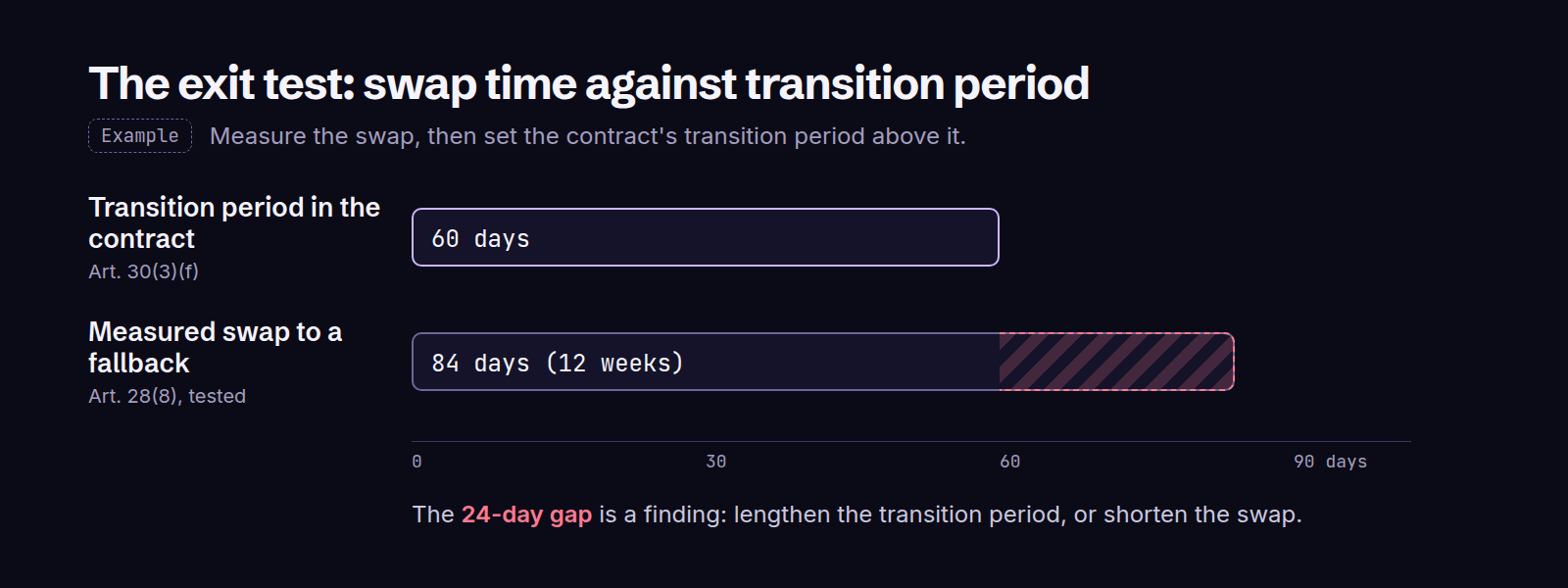
Example numbers. Measure your own swap, then set the transition period in the contract above it.
A one-page checklist and five questions for the vendor call
Copy this list into your review. The references are to DORA Article 30 unless stated.
Before you sign
- The tier is decided and recorded: critical or important function or not (Article 28(4)(a)).
- The description lists the agent’s functions and which actions wait for a person; subcontracting is permitted or not, with conditions (30(2)(a)).
- Three locations are named (platform, model step, logs and backups), with advance notice of a change (30(2)(b)).
- The security schedule covers availability, authenticity, integrity and confidentiality, personal data included (30(2)(c)).
- Return of data lists documents, index, test sets, run records and specification, each with a format, and applies on insolvency and on termination (30(2)(d)).
- Service levels hold uptime and a pass bar, and say how updates are handled (30(2)(e), 30(3)(a)).
- Incident help is free or priced in advance, and material developments are reported (30(2)(f), 30(3)(b)).
- Audit and access rights cover you and the authorities, with a pooled-audit or alternative-assurance route defined; the vendor cooperates with authorities (30(3)(e), 30(2)(g)).
- The chain is named, with notice and objection for changes, audit rights passed down and a termination right (Delegated Regulation (EU) 2025/532).
- Termination rights and notice periods are set, with a transition period you have tested against a swap (30(2)(h), 30(3)(f), Article 28(8)).
- Beyond DORA: model change notice, release test results, run record retention and no training on your data.
Five questions for the vendor call
- Which companies touch our data, in order, from your platform to the model and the host?
- Where is each model call processed, and where do prompts, outputs and logs rest?
- How long before a model is retired or replaced do you tell us, and what do you test before the switch?
- Show a release record: pass bar, test set, safety cases and who approved.
- How long would it take to move us out, and what do we get back, in which format?
Here is how we answer them today. Our trust page lists the sub-processors with the date they were checked. It says the model provider and route are named for each deployment in your contract, and that a change to the sub-processor list is announced in advance so you can object. Every run on the platform is recorded step by step, with the sources, tools and model used and who approved, and we provide extracts on request. There is also a DORA and NIS2 supplier annex, available on request before you sign. It covers the service description, where data is processed and stored, security and availability, sub-contracting, help in an incident, your audit and access rights, termination rights and an exit plan. Where your own clauses ask for something we cannot do yet, we say so before signing. Our page on AI agents for banks, insurers and other regulated firms shows the processes we build agents for.
Bring one process. In 45 minutes you get a first view of its risk class, the controls it needs and whether an agent is the right tool at all. Book a scoping call.
Questions
Does DORA apply to a vendor that sells an AI agent to a bank?
The bank is the financial entity and must put the Article 30 clauses in the contract. The vendor is then an ICT third-party service provider that accepts them and passes some down to its own subcontractors. A hosted AI agent fits DORA's broad definition of an ICT service (Article 3(21)).
What is the difference between Article 30(2) and 30(3)?
Article 30(2) lists nine elements for every contract on ICT services. Article 30(3) adds six more, such as audit rights and exit strategies, for services that support critical or important functions. The bank decides which tier applies before it signs (Article 28(4)(a)).
Does the model provider behind the vendor have to sign the bank's contract?
Not necessarily. For critical or important functions, the bank's contract with the vendor must make the vendor responsible for its subcontractors and require the subcontractor to grant the bank and the authorities the same audit and access rights (Delegated Regulation (EU) 2025/532, Article 4(1)).
Is a model retirement a change the vendor must tell the bank about?
Not clearly. The subcontracting standard covers material changes to subcontracting arrangements, such as a new model provider. A version retirement inside the same provider may not count, so write a model change notice and a re-test result into the contract.
Sources
- eur-lex.europa.eueur-lex.europa.eu/eli/reg/2022/2554/oj
- eur-lex.europa.eueur-lex.europa.eu/eli/reg_del/2025/532/oj
- eur-lex.europa.eueur-lex.europa.eu/eli/reg_del/2024/1773/oj
- eur-lex.europa.eueur-lex.europa.eu/eli/reg_impl/2024/2956/oj
- advisera.comadvisera.com/dora-regulation/key-contractual-provisions/
- bastion.techbastion.tech/learn/dora/contractual-requirements
- www.eba.europa.euwww.eba.europa.eu/publications-and-media/press-releases/european-supervisory-authorities-designate-critical-ict-third-party-providers-under-digital
- www.eba.europa.euwww.eba.europa.eu/sites/default/files/2025-11/e388451b-356b-408a-bbf2-b8e425865d75/List%20of%20designated%20CTPPs.pdf
- www.swfte.comwww.swfte.com/blog/dora-ai-vendors-exit-plans-concentration-risk
- www.esma.europa.euwww.esma.europa.eu/sites/default/files/2026-07/JC_2026_25_ESA_statement_on_frontier_AI_models.pdf
- www.goodwinlaw.comwww.goodwinlaw.com/en/insights/publications/2026/08/alerts-technology-fs-frontier-ai-dora-service-providers-to-eu-financial-entities-take-note
- docs.claude.comdocs.claude.com/en/docs/about-claude/model-deprecations
- platform.openai.complatform.openai.com/docs/deprecations
- platform.openai.complatform.openai.com/docs/guides/your-data
- artificialintelligenceact.euartificialintelligenceact.eu/article/26/
- gdpr-info.eugdpr-info.eu/art-28-gdpr/
- wiseagents.aiwiseagents.ai/trust.html
- wiseagents.aiwiseagents.ai/platform.html
- wiseagents.aiwiseagents.ai/contact.html
- www.eiopa.europa.euwww.eiopa.europa.eu/european-supervisory-authorities-designate-critical-ict-third-party-providers-under-digital-2025-11-18_en
Read on or before 15 November 2026. Not legal advice: your counsel and data protection officer decide.
Related posts

AI Act high risk insurance and banking: which AI is listed?
AI Act high risk insurance and banking rules, process by process: what Annex III lists, what it leaves out, and the date your team should plan against.
Read
AI Agent Audit Logs: What to Record and How Long to Keep It
AI agent audit logs: the fields to record for every run, what AI Act Articles 12, 19 and 26(6) and GDPR say about keeping them, and a review routine.
Read
AI Literacy Training: What Article 4 Asks, and a Staff Plan
AI literacy under Article 4 now means supporting it, not guaranteeing it. What changed, who enforces it, and a training plan by role for 200 people.
Read