
Example: a product lead at a consumer lender opens a ticket. “Our loan rejection email is a template from years ago. Does it still work after 20 November?” Under the new EU consumer credit directive, a rejection notice has specific elements to carry, and the ads, the difficulty letters and the complaint replies each meet an article.
The new directive is Directive (EU) 2023/2225, often called CCD2. Member States must apply their national rules for it from 20 November 2026 (Article 48(1)). An AI agent can draft most of the messages it touches and check them against the rule. A person at the lender should still make every decision those messages report.
In short
- Member States must apply CCD2 from 20 November 2026. The 2008 directive is repealed that day, but keeps applying to credit agreements that already exist until they end. Where a country’s law is late, check it: for Spain, the 2008 framework is reported to still cover borrowers.
- Six customer messages change or need a second look: ads, the notice of a right to a human, rejections, difficulty letters, complaint replies, and the “you are talking to an AI” line under the AI Act.
- An agent drafts and checks; a person decides. That split is the design we recommend for every message below.
- National law decides the details. As of October 2026, news reports said 16 Member States had not told the Commission they had fully transposed it.
We read every article cited here on 13 November 2026, from the directive’s text on EUR-Lex and the AI Act’s text on artificialintelligenceact.eu. This is an engineer’s reading, not legal advice. Your counsel should confirm it against your country’s transposing law.
What applies on 20 November 2026?
On 20 November 2026, Member States must start applying their national rules for CCD2 (Article 48(1)), and the 2008 consumer credit directive is repealed. Article 47 says “Directive 2008/48/EC is repealed with effect from 20 November 2026”, and that the old directive continues to apply to credit agreements existing on that date until their termination. Where a country’s transposing law is not yet in force, the picture is less clean; we cover that below.
There is one exception to keep on your list. A set of the new articles (23, 24, 25(1) second sentence, 25(2), 28 and 39) applies to all open-end credit agreements existing on 20 November 2026. So an existing credit line is not fully on the old rules. The scope is wider too: Brussels Signal reports that the directive widens EU consumer protection to buy now, pay later schemes, micro-loans below €200 and crowdfunding credit. If you offer any of those, check them against the list below too.
Which customer messages change, and under which article?
Six messages, one row each. The last column is what we would have a person decide.
| Message | Article | What the rule asks | What the agent drafts or checks | What a person decides |
|---|---|---|---|---|
| Advertising and marketing | CCD2 Art. 7, 8 | Fair, clear, not misleading. A clear and prominent warning that borrowing costs money. A representative example when a rate or cost figure appears. | Checks each draft ad for the warning and the standard information, and flags what is missing | Approves every ad |
| Notice of the right to a human | CCD2 Art. 18(8) | Where the assessment uses automated processing, the consumer is told of the right to human intervention | Drafts the notice; logs a request and assembles the file | Does the review |
| Rejection notice | CCD2 Art. 18(9) | Inform without delay; where relevant, refer to debt advice; where applicable, say the assessment was automated and how to contest it | Drafts the notice from the recorded decision | The decision, and sending |
| Financial difficulty | CCD2 Art. 35, 36 | Early detection processes; referral to debt advice; reasonable forbearance before enforcement | Drafts the acknowledgment and the debt-advice referral, and routes the case | Any payment plan, forbearance or enforcement step |
| Complaint reply | CCD2 Art. 40 | Member States ensure out-of-court dispute resolution | Registers the complaint and drafts the reply, naming the route | The outcome, and sending |
| “You are talking to an AI” | AI Act Art. 50 | People are told they are interacting with an AI system, at the latest at the first interaction | Shows the line in the first message of every conversation | Approves the wording once |
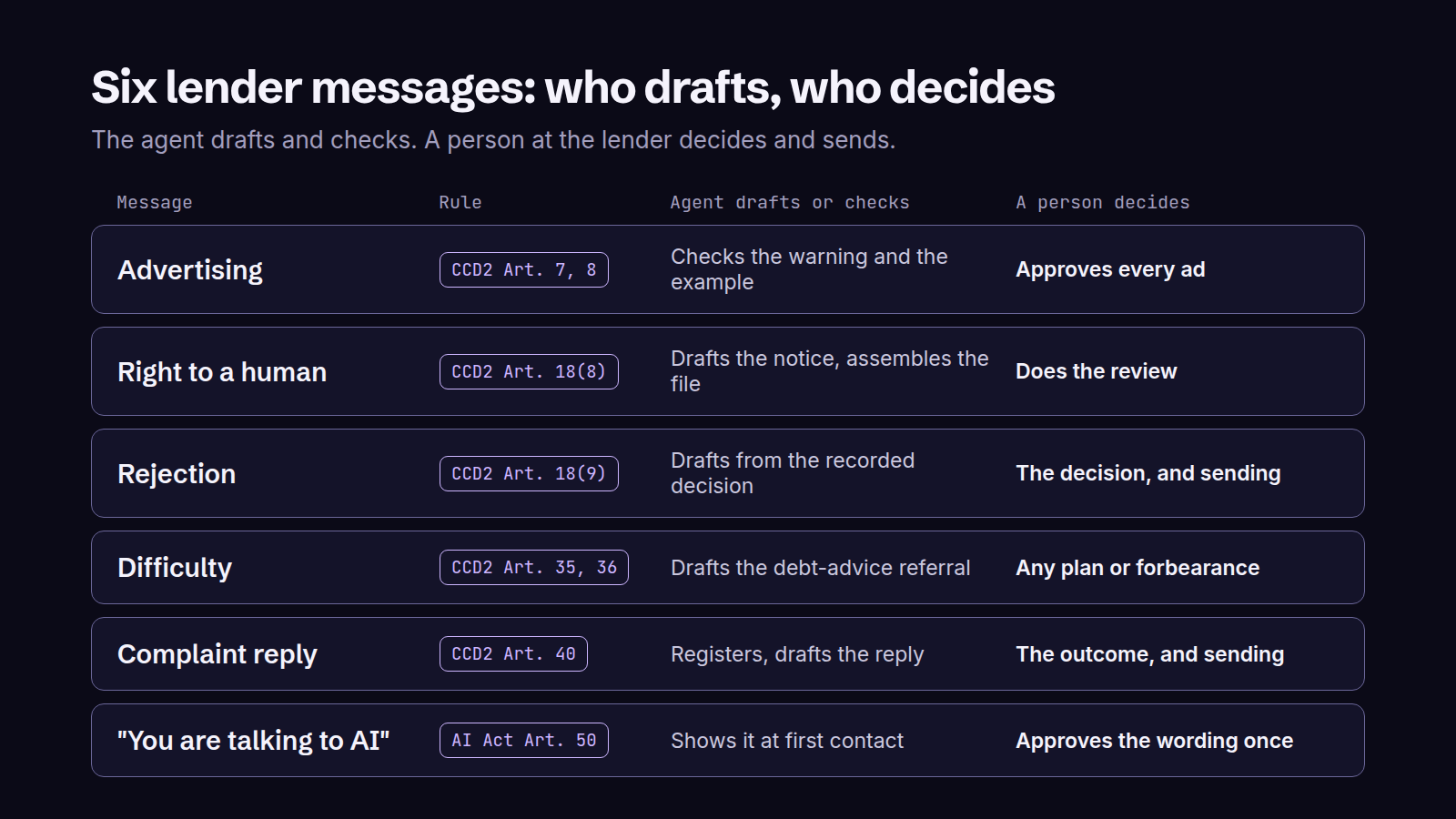
One row per message: advertising, the right to a human, rejection, difficulty, complaint reply and the AI line. The person column holds every decision. Drawn for this post.
Advertising (Articles 7 and 8)
Article 7 asks that advertising and marketing communications concerning credit agreements are “fair, clear and not misleading”. Article 8(1) asks for a clear and prominent warning, using the wording “Caution! Borrowing money costs money” or an equivalent wording.
When an ad states an interest rate or any cost figure, it must include standard information, given by a representative example (Article 8(2) and 8(4)). That information includes the borrowing rate, the total amount of credit and the annual percentage rate of charge (Article 8(3)(a) to (c)).
This is the easiest place to start with an agent. A checklist this concrete is something an agent can test every draft against, before a person signs it off.
The right to a human, and the rejection notice (Article 18(8) and (9))
Where a creditworthiness assessment involves automated processing of personal data, the consumer has “the right to request and obtain from the creditor human intervention”. That means an explanation of the assessment, a chance to give their own point of view, and a review of the decision (Article 18(8)). The consumer must be told of that right.
The rejection notice (Article 18(9)) is where the two meet: when the assessment was automated, the rejection itself has to point to the right to a human and to the way to contest the decision. That makes it a good test case. Example: a rejection draft built from an automated assessment, with the human-assessment line left out, must fail the agent’s checks.
An agent is good at this kind of letter. It reads the recorded decision, fills in each required element, and is tested to flag any draft with one missing. The decision itself stays with a person.
Financial difficulty (Articles 35 and 36)
Creditors must have “processes and policies in place for the early detection of consumers experiencing financial difficulties”, and must refer those consumers to debt advisory services easily accessible to them (Article 36(2) and (3)). Article 35(1) asks creditors to exercise, where appropriate, reasonable forbearance before enforcement proceedings start, taking the consumer’s circumstances into account.
When a customer writes that they are struggling, the agent drafts the acknowledgment and the debt-advice referral and routes the case to a person. The early-detection process itself stays one the lender owns. We would not let it offer a payment plan. Anything that changes what a person in difficulty owes or when they pay is a decision for a person.
Complaints (Article 40)
Article 40(1) asks Member States to ensure access to “adequate, prompt and effective out-of-court dispute resolution procedures” between consumers and creditors. Naming that route in every complaint reply is our recommendation, not a quote from the article. It is a line an agent can add every time and a person can check once.
The AI line (AI Act Article 50)
If the agent talks to customers directly, a second law joins in. Article 50(1) of the AI Act asks providers to design such systems so that “the natural persons concerned are informed that they are interacting with an AI system”, unless that is obvious to a reasonably well-informed person. Article 50(5) says this happens at the latest at the time of the first interaction. The AI Act applies from 2 August 2026 (Article 113).
Where does the agent stop?
The agent stops at the loan decision. In the design we describe, it drafts messages about a creditworthiness assessment and never makes one.
The assessment has its own rules. Article 18(3) bars special categories of personal data from it, and says social networks “shall not be considered as an external source”. Under the AI Act, high-risk rules for Annex III systems apply from 2 December 2027 (Article 113). Whether a scoring model falls under them, and who carries which duty, is in the EU AI Act for companies deploying AI agents. What GDPR asks of an agent that touches personal data is in the seven questions your DPO will ask.
This is the design we propose for a lender, as for other regulated sectors: the agent drafts and checks against the rule, and a named person decides. Every run of the agents we build is recorded. The article checklist belongs in the agent’s tests, one test case per required element. How to design the approval step itself is in designing the approval step an auditor will accept.
What if your country has not transposed CCD2?
Then national law still decides what applies, so check it country by country. Member States had to adopt and publish their transposing measures by 20 November 2025 (Article 48(1)).
Many did not. As of October 2026, 16 Member States had still not notified the Commission of full transposition, Hina reported via Croatia Week. Brussels Signal reports that the Commission sent formal notices to 23 Member States in January 2026, and reasoned opinions on 1 October. For Spain, it reports that until the national law is in force, borrowers remain covered by the framework agreed in 2008.
So do not assume CCD2 applies the same way everywhere. A lender in several countries may need one message set per country for a while. We would keep one checklist per country, each with its own test cases.
A checklist before 20 November
Copy this and work through it with your counsel:
- List every template your customers receive: ads, rejection notices, difficulty letters, complaint replies, chat greetings.
- For each, note the country and whether its transposing law is in force there.
- Check every ad for the borrowing-costs-money warning and, where a rate or cost appears, the representative example (Art. 8).
- If any assessment step is automated, add the right-to-a-human notice (Art. 18(8)) and the three extra lines in the rejection notice (Art. 18(9)).
- Add the debt-advice referral to rejections, where relevant, and to difficulty letters (Art. 18(9), 36).
- Our recommendation: name the out-of-court dispute route in complaint replies. Art. 40(1) asks Member States to ensure access to it; ask counsel whether your national law requires the reply to name it.
- Make sure the AI line appears in the first message of any customer chat run by an agent. The duty sits with the AI system’s provider, so confirm with your provider and counsel who shows it (AI Act Art. 50).
- Write down, per message, who drafts and who decides. Keep that page with the template.
- Flag open-end agreements that existed before 20 November: some new articles apply to them (Art. 47).
FAQ
When does the new EU consumer credit directive apply?
Member States must apply their national measures from 20 November 2026 (Article 48(1) of Directive (EU) 2023/2225). The 2008 directive is repealed on that date, but it keeps applying to credit agreements that existed on 20 November 2026 until they end.
Does CCD2 apply to existing credit agreements?
Mostly not: the 2008 directive keeps applying to agreements existing on 20 November 2026 until they end (Article 47). The exception is open-end credit. Articles 23, 24, 25(1) second sentence, 25(2), 28 and 39 apply to all open-end agreements existing on that date.
What must a loan rejection notice say under CCD2?
The creditor must inform the consumer without delay and, where relevant, refer them to debt advisory services (Article 18(9)). Where the assessment used automated processing, the notice must say so, and give the right to human assessment and the procedure for contesting the decision.
Can an AI agent send customer messages for a lender?
An agent can draft them and check each one against the article it answers. In the design we recommend, a person makes every decision a message reports, such as a rejection or a payment plan. If the agent chats with customers directly, the AI Act’s Article 50 asks that they are told they are talking to an AI, at the latest at the first interaction.
What if my country has not transposed CCD2 yet?
Check your national law with counsel. As of October 2026, 16 Member States had still not notified full transposition, according to news reports. For Spain, Brussels Signal reports that borrowers remain covered by the 2008 framework until the national law is in force.
The table above is the map we would want if we owned these templates; your counsel confirms it against your national law. Bring one process. In 45 minutes you get a first view of its risk class, the controls it needs and whether an agent is the right tool at all. Book a scoping call.
Sources
- eur-lex.europa.eueur-lex.europa.eu/eli/dir/2023/2225/oj/eng
- www.croatiaweek.comwww.croatiaweek.com/european-commission-croatia-eu-law-renewable-energy-consumer-credit/
- brusselssignal.eubrusselssignal.eu/2026/10/brussels-threatens-spain-with-court-action-over-consumer-credit-delay/
- artificialintelligenceact.euartificialintelligenceact.eu/article/50/
- artificialintelligenceact.euartificialintelligenceact.eu/article/113/
Read on or before 13 November 2026. Not legal advice: your counsel and data protection officer decide.
Related posts

AI Act high risk insurance and banking: which AI is listed?
AI Act high risk insurance and banking rules, process by process: what Annex III lists, what it leaves out, and the date your team should plan against.
Read
AI Agent Audit Logs: What to Record and How Long to Keep It
AI agent audit logs: the fields to record for every run, what AI Act Articles 12, 19 and 26(6) and GDPR say about keeping them, and a review routine.
Read
AI Literacy Training: What Article 4 Asks, and a Staff Plan
AI literacy under Article 4 now means supporting it, not guaranteeing it. What changed, who enforces it, and a training plan by role for 200 people.
Read