
A typical board question about a new claims agent is a simple one: “What happens if we have to leave this vendor?” For an AI agent, the honest answer has five parts, and the contract reaches only part of them. Lock-in sits in the model, in the prompts tuned to that model, in the tools, in your test data and run records, and in the vendor’s platform.
The EU Data Act helps with the last part. From 12 January 2027, a provider of data processing services may not charge you for switching at all, if your service is one the Act covers (whether AI services are is still open, so ask counsel). It does not make your prompts work on another model, and it does not move your test set for you. That part is design, and you can start it today.
In short
- Lock-in is a design problem first. Keep the model call behind one interface, and keep prompts, tool definitions and test sets as your own files.
- Models will be retired anyway. Treat a model swap as a routine release, tested against the same pass bar.
- Write the exit plan down and test it. For financial entities under DORA, it is a legal duty for ICT services that support critical or important functions. For everyone else, it is a good template.
- 12 January 2027 removes switching charges. Early termination fees are still allowed, and whether AI services are in scope is an open question for counsel.
We read every article cited here on 12 November 2026, from Springlex’s reproduction of the Official Journal texts, not from EUR-Lex itself. This is an engineer’s reading, not legal advice. Your counsel should confirm it against the official text.
What does lock-in look like for an AI agent?
Lock-in for an agent is the cost of leaving, spread over five layers. A cloud contract mainly reaches the platform and the data a provider holds for you. The model, the prompt behavior and the tools are a matter of how the agent was built.
Braintrust, a vendor of evaluation tooling, puts the core of it in one line: “Provider portability requires code, behavior, and evaluation data to remain movable.“ The behavior part is the one teams miss. A new model may accept the same prompt and still give materially different results, because prompts get refined around one model’s formatting, verbosity, refusals and tool calls.
The five layers, what to keep in your own hands, what to test in a swap drill, who should own it, and what law helps:
- Model (code written against one API). Keep one interface for every model call. Test that the agent runs on the alternative route. Owner: the IT lead. Law that helps: none.
- Prompt behavior (prompts tuned to one model). Keep prompts as versioned files, with the cases that prove them. Test that the full test set passes the same bar. Owner: the business owner of the process. Law that helps: none.
- Tools (definitions in a vendor’s format). Keep tool definitions on an open protocol. Test that every tool call works on the new model. Owner: the IT lead. Law that helps: none.
- Data and records (test sets, run records). Keep an export in a plain format you have opened yourself. Test that a fresh export opens and is complete. Owner: compliance. Law that helps: Data Act Article 25, for data the provider holds.
- Platform (hosting, contract, terms). Keep an exit plan and the Data Act contract terms. Test that notice, transition and retrieval dates are in the contract. Owner: procurement with counsel. Law that helps: Data Act Articles 25 and 29, if in scope; DORA Article 28(8) for financial entities.
Read the law from top to bottom. It reaches the platform and the data a provider holds for you. It says nothing about whether your prompts and tools still work on another model.
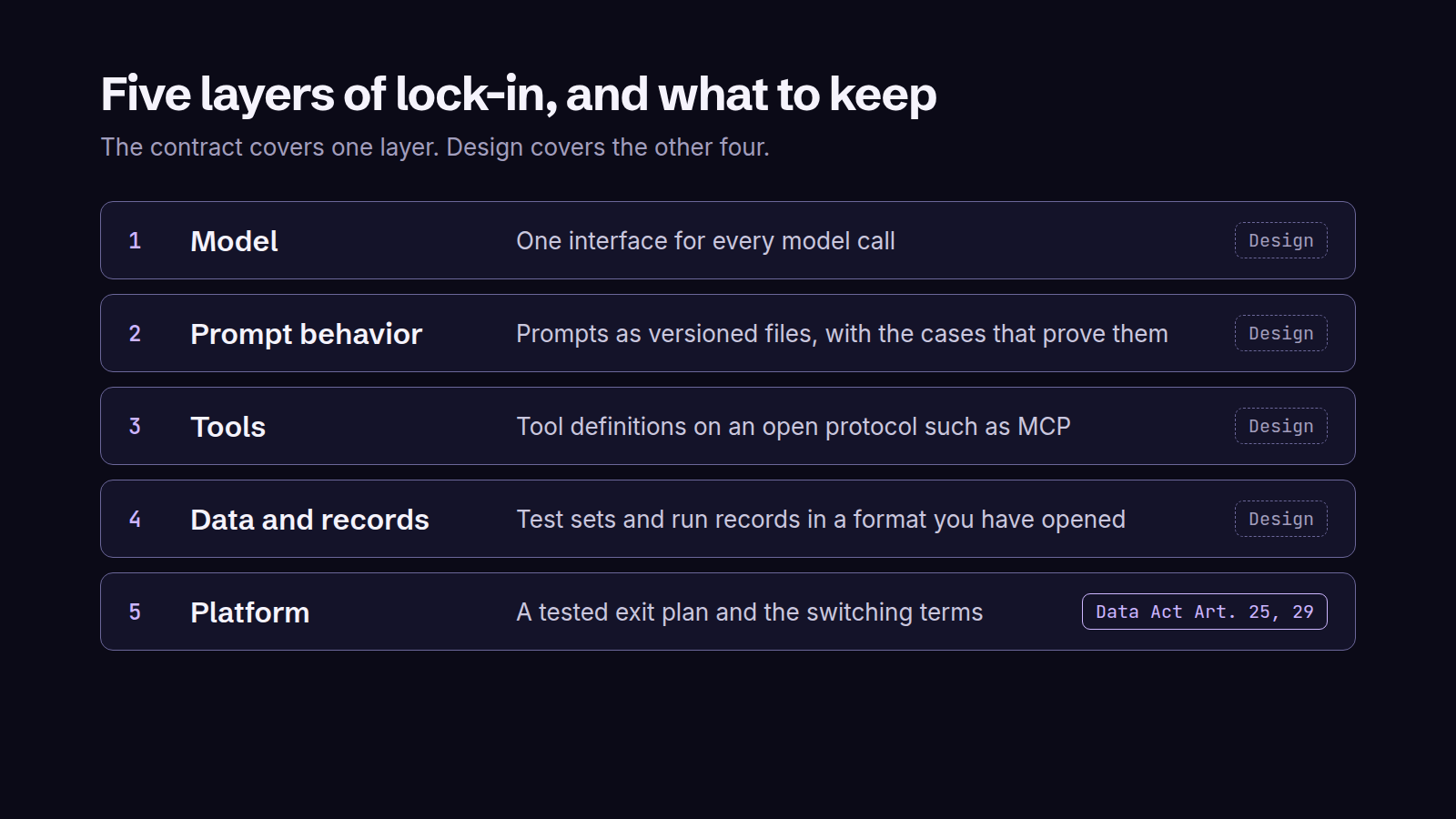
The first four layers are marked Design; the platform row carries Data Act Articles 25 and 29. The diagram simplifies layer 4: Article 25 also reaches the data a provider holds for you. Drawn for this post.
The quick rule: ask “what would we need on day one of an exit?” Then build that from day one.
How do you design an agent for a model swap?
Design for the swap by keeping everything that is yours outside the model call. Three habits do most of the work.
- One interface for the model. Every part of the agent calls the model through a single function or service. Changing the model then touches one place, not fifty.
- Prompts, tool definitions and test sets as your own files. Version them like code. A prompt that lives only in a vendor’s console is a prompt you can’t take with you.
- Open protocols for tools. The Model Context Protocol (MCP; in plain words, a common way to plug tools into a model) now sits in the Linux Foundation’s Agentic AI Foundation, alongside Block’s goose and OpenAI’s AGENTS.md. The foundation describes itself as “a neutral, open foundation“. We read that as a good reason to write tools for a shared protocol rather than one vendor’s format. Still test each tool on the model you would move to.
A sketch of the first habit:
# agent/model.py: the only place that knows which model is used
def complete(messages, tools, *, route):
    """route comes from config, e.g. {"provider": "...", "model": "..."}"""
    client = CLIENTS[route["provider"]]
    return client.complete(model=route["model"], messages=messages, tools=tools)
A shared API gateway does the same job at the network level. It is useful, but it solves less than it seems. Braintrust, which sells such tooling, puts it this way: a shared API confirms that requests reach the new model, and whether the outputs meet your quality requirements still takes evaluation. The interface removes the code coupling. It does not remove the behavior coupling.
Even with perfect design, you will swap models. Anthropic, for example, commits to “at least 60 days’ notice before model retirement for publicly released models“, and requests to a retired model fail. It says plainly that applications relying on its models may need occasional updates to keep working. So the question is not whether you swap, but whether a swap is a routine release or an emergency.
How do you prove a swap is safe?
You prove it the same way you proved the first release: same test set, same scorers, same pass bar. Braintrust’s advice is to run “the current and candidate models against the same dataset and scorers, and investigate every regression that crosses a release threshold“. Anthropic gives the timing advice: test with newer models well before the retirement date of your current one.
This is where test data pays twice. Test sets, traces and examples kept in a provider-neutral form serve the migration in front of you and the next model review too.
It is also how we build. Every Wise Agents agent is tested against a pass bar the client signs, every run is recorded, and a named person approves each release. A pass bar the client signs is the kind of test set a swap needs: written down and agreed before anything changes. The approval step itself is covered in designing the approval step an auditor will accept.
What goes in a written exit plan?
An exit plan says how you would leave, to where, in what time, and how you know it works. DORA gives the clearest model.
DORA Article 28(8) applies to financial entities as DORA defines them; counsel confirms whether your firm is one. For ICT services supporting critical or important functions, they must put in place exit strategies that take account of provider failure, deteriorating quality and business disruption. The article asks for three things:
- Exit plans that are comprehensive, documented, and sufficiently tested and reviewed periodically.
- Alternative solutions and transition plans to remove the services and data and move them securely to another provider or back in-house.
- The ability to exit without disrupting the business, limiting regulatory compliance, or harming the continuity and quality of services to clients.
Your counsel should confirm whether an agent supports a critical or important function in your firm. If you are not a financial entity, DORA does not bind you. Its structure is still a good template.
A one-page exit plan for one agent:
EXIT PLAN: <agent name>, <process>          Owner: <name>   Reviewed: <date>

1. Trigger       What makes us leave (provider failure, quality drop, contract end)
2. Target        Alternative model route / provider / in-house
3. Our assets    Prompts, tool definitions, test set, run records: where each lives
4. Export        What we can export, in which format, last test export: <date>
5. Swap test     Test set + scorers + pass bar; last drill result: <date, pass/fail>
6. Timeline      Notice period, transition period, data retrieval window
7. Continuity    How the process runs during the switch (manual fallback)
8. Erasure       Confirmation the old provider erased our data
9. Approval      Who signs off the new release
How do you test it? Our recommendation, not a legal rule: run a swap drill at least once a year, and again when a model retirement is announced. Point the agent at the alternative route, run the full test set, and record the result. A plan with a recent passing drill is an exit plan. A document nobody ran is a wish.
Example of one drill, step by step:
- Freeze the current prompts, tool definitions and test set at a tagged version.
- Change only the route in config to the alternative model.
- Run the full test set with the same scorers.
- Compare with the current model, case by case. Investigate every regression that crosses the release threshold.
- Export the run records and open the export.
- Record the result in the exit plan: pass if the candidate meets the signed bar and the export is complete, fail otherwise, with the cases that failed.
A failed drill is still useful. It tells you which prompts or tools tie you to the current model while you have time to fix them.
What does the Data Act change on 12 January 2027?
From 12 January 2027, providers of data processing services may not impose any switching charges on the customer for the switching process. That is Article 29(1) of Regulation (EU) 2023/2854, the Data Act. Who counts as a provider of data processing services? Latham & Watkins reads the definition as broad, covering infrastructure, platform and software as a service (IaaS, PaaS and SaaS). Germany’s Bundesnetzagentur says the same in its glossary: “From 12 January 2027, no switching charges at all may be imposed“.
Until that date, a provider may charge reduced switching charges, capped at its costs directly linked to the switching (Article 29(2) and (3)). Most of the switching obligations themselves already took effect on 12 September 2025, according to Latham & Watkins.
What the switching rules do and do not cover:
- Are early termination fees banned? No. Before a contract, the provider must tell you about standard fees and early termination penalties (Article 29(4)). Latham & Watkins notes the Act does not prohibit early termination fees or fixed contract terms.
- Does it cover a service built just for us? Services mostly custom-built for one customer, and not offered at broad commercial scale, are exempt from Article 29 and some other duties, including Articles 23(d) and 30(1) and (3) (Article 31). The provider must tell you which obligations do not apply.
- Does it cover a trial? No. Non-production versions for testing and evaluation, for a limited period, are outside the chapter (Article 31).
- Can we run old and new providers in parallel? Yes, and Latham & Watkins reads the switching rules as covering that case too.
- Is a model API in scope? Open. Latham & Watkins lists “whether AI (which is often delivered using an “as-a-service” model) is subject to the Data Act obligations” as a question of interpretation. Ask counsel.
The limit of the law is worth saying plainly. The Data Act prices and times a switch. It does not keep your prompts working on a new model or your test set passing. That part stays with you.
What should the contract say?
Use Article 25 as a checklist. It binds providers the Act covers; for a model vendor, that is the open scope question above, but the list is a good standard to ask for either way. It lists what a switching contract with a data processing provider must contain at a minimum:
- Notice period: at most two months to start a switch.
- Transitional period: at most 30 calendar days, during which the provider gives reasonable assistance and keeps the service running.
- If 30 days is technically unfeasible: the provider must tell you within 14 working days, justify it, and propose an alternative of at most seven months.
- Data retrieval: at least 30 calendar days after the transitional period.
- What can be exported: an exhaustive list of all categories of data and digital assets that can be ported, including at least all exportable data.
- Exit support: an obligation to support your exit strategy, including all relevant information.
- Erasure: full erasure of your exportable data after the retrieval period, once the switch is complete.
For an agent, point 5 is the one to read slowly. Check that your prompts, tool definitions, test sets and run records are on the list by name. For personal data, the erasure point sits next to your GDPR processing contract; we covered that in the seven questions your DPO will ask. Who carries which duty for the agent itself, provider or deployer, is in the EU AI Act for companies deploying AI agents.
Five questions for your next vendor call
- If we leave, which of our prompts, tool definitions, test sets and run records can we export, and in what format?
- Is that list written in the contract, by category?
- Which Data Act obligations do you say do not apply to this service, and why?
- What notice period, transition period and retrieval window does the contract give us?
- When you change or retire a model, how much notice do we get, and do we see the test results before the release?
A good answer is specific and written: named data categories, a format, dates in days. A vague answer tells you where your exit plan has work to do.
FAQ
What is vendor lock-in for an AI agent?
It is the cost of leaving a vendor, spread over five layers: the model, the prompts tuned to that model, the tools, your test data and run records, and the vendor’s platform. A contract mainly reaches the platform and the data a provider holds for you. The model, prompts and tools depend on how the agent was built.
Does the Data Act ban switching charges?
From 12 January 2027, providers of data processing services may not charge the customer for the switching process (Article 29(1)). Until then, they may charge only reduced switching charges, capped at their costs directly linked to the switch. Early termination fees and fixed contract terms are still allowed.
Does the Data Act apply to a model API?
That is an open question. Latham & Watkins lists whether AI delivered as a service is subject to the Data Act obligations as a matter of interpretation. Ask your counsel before you rely on it.
Do we need a written exit plan if we are not a financial entity under DORA?
Not under DORA, which binds financial entities for ICT services that support critical or important functions. Counsel confirms whether your firm is one. For everyone else, its structure is still a good template: a documented plan, an alternative route, and a test that proves you can leave without disrupting the business.
How often should we test a model swap?
Run a swap drill at least once a year, and again when a model retirement is announced. Anthropic, for example, gives at least 60 days’ notice before it retires a publicly released model, and advises testing with newer models well before that date.
We build every agent with a signed pass bar, a record of every run and a named person who approves each release. Bring one process. In 45 minutes you get a first view of its risk class, the controls it needs and whether an agent is the right tool at all. Book a scoping call.
Sources
- www.springlex.euwww.springlex.eu/en/packages/data-act/data-act-regulation/article-29/
- www.bundesnetzagentur.dewww.bundesnetzagentur.de/SharedDocs/A_Z_Glossar_DataAct_ENG/S/switching-charge.html
- www.lw.comwww.lw.com/en/insights/eu-data-act-significant-new-switching-requirements-due-to-take-effect-for-data-processing-services
- www.springlex.euwww.springlex.eu/en/packages/data-act/data-act-regulation/article-25/
- www.springlex.euwww.springlex.eu/en/packages/data-act/data-act-regulation/article-31/
- www.springlex.euwww.springlex.eu/en/packages/dora/dora-regulation/article-28/
- www.braintrust.devwww.braintrust.dev/articles/avoid-llm-provider-lock-in-2026
- docs.claude.comdocs.claude.com/en/docs/about-claude/model-deprecations
- www.linuxfoundation.orgwww.linuxfoundation.org/press/linux-foundation-announces-the-formation-of-the-agentic-ai-foundation
Read on or before 12 November 2026. Not legal advice: your counsel and data protection officer decide.
Related posts

AI Act high risk insurance and banking: which AI is listed?
AI Act high risk insurance and banking rules, process by process: what Annex III lists, what it leaves out, and the date your team should plan against.
Read
AI Agent Audit Logs: What to Record and How Long to Keep It
AI agent audit logs: the fields to record for every run, what AI Act Articles 12, 19 and 26(6) and GDPR say about keeping them, and a review routine.
Read
AI Literacy Training: What Article 4 Asks, and a Staff Plan
AI literacy under Article 4 now means supporting it, not guaranteeing it. What changed, who enforces it, and a training plan by role for 200 people.
Read